Probability trees and Venn diagrams
What a tree diagram is for
- A tree diagram maps out events that happen in stages — two coin tosses, two counters drawn from a bag, a test followed by a re-test.
- Each branch is one possible outcome of that stage, labelled with its probability.
- The branches leaving any one point always add to 1, because something must happen. This is the fastest way to check you have not missed a branch or mislabelled one.
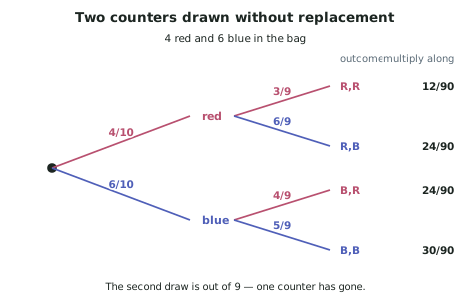
- Each complete path from left to right is one overall outcome, and every path together covers every possibility exactly once.
The two rules: multiply along, add between
- Multiply ALONG a path — this and then that.
- The stages happen one after another, so both must occur for that path to be the outcome.
- A path's probability is the product of every branch on it.
- ADD separate paths — this path or that path.
- Different paths are different ways of succeeding, and only one of them can actually happen.
- A quick way to keep them straight: "and" narrows things down, so the number gets smaller (multiplying); "or" gives you more ways to win, so the number gets bigger (adding).
- "At least one" is almost always easier backwards. There are usually many paths with at least one success but only one path with none at all:
With and without replacement
- With replacement — the item goes back in, so the bag is identical for the second draw.
- The totals are unchanged, so every stage has the same probabilities.
- The stages are independent: the first result tells you nothing about the second.
- Without replacement — the item is kept out, so the bag has changed.
- The total drops by one, and so does the count of whatever was taken.
- The second-stage probabilities are different on every branch, because what is left depends on what was drawn first.
- The stages are dependent — the second-stage branches are conditional probabilities.
- Decide which one applies before drawing anything. The phrase to hunt for is "replaced" or "not replaced"; failing that, ask whether the item could physically be picked twice.
Venn diagrams
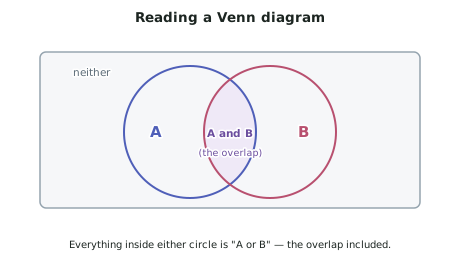
- A Venn diagram shows events as overlapping circles inside a rectangle that represents every possible outcome.
- Reading the regions:
- the overlap (intersection) is " and " — outcomes in both
- everything inside either circle is " or " (the union) — including the overlap
- the space outside both circles is "neither", which is easy to forget and often carries a mark
- "Or" in mathematics includes both. Everyday English often means one or the other but not both; a Venn diagram makes the difference visible.
Mutually exclusive is not the same as independent
- Mutually exclusive events cannot both happen:
- their circles do not overlap at all
- example: a single card is a heart or a spade, never both
- Independent events do not affect each other's chances:
- example: two separate coin tosses
- These two ideas are opposites, not synonyms — and confusing them is the most common conceptual error in the topic.
- Mutually exclusive events are strongly dependent: if one happens, the other definitely cannot, so knowing about one tells you a great deal about the other.
- Independent events with non-zero probabilities must overlap, because they can both happen at once.
Worked ExampleMultiplying along a path
A fair coin is tossed twice. Find the probability of getting two heads.
Step 1 — Probability of heads each toss
Each toss is independent with .
Step 2 — Multiply along the H–H path
"Heads and heads" means multiply along the single path:
Worked ExampleDrawing without replacement
A bag has 4 red and 6 blue counters. Two are drawn without replacement. Find the probability that both are red.
Step 1 — First draw
Step 2 — Second draw (one red already gone)
Now 3 red remain out of 9 counters:
Step 3 — Multiply along the path
Worked Example"At least one" — using the complement
The same bag holds 4 red and 6 blue counters. Two counters are drawn without replacement.
Find the probability that at least one is red.
Step 1 — List what "at least one red" actually covers
Three of the four paths qualify: red-red, red-blue, and blue-red. Only blue-blue does not.
Step 2 — Turn it around, because one path is quicker than three
Everything except blue–blue counts, so:
Step 3 — Find the single unwanted path
First draw: 6 blue out of 10. Second draw: one blue is gone, so 5 blue out of 9 remain:
Step 4 — Subtract from 1