The objective function and testing the vertices
The objective function
- The objective function is the quantity you want to maximise (profit, output) or minimise (cost, waste).
- It is written in terms of the decision variables, e.g. profit:
- — the value being optimised (here, profit in dollars).
- — the profit per table (the amount each unit of contributes).
- — the profit per chair (the amount each unit of contributes).
- The objective function is not a constraint — it has no inequality sign.
Why the optimum is at a vertex
- The objective function has a constant slope, so lines of equal value are all parallel.
- As grows, the line sweeps across the feasible region without changing direction.
- The last point it touches before leaving the region is a corner — so the maximum (and the minimum) must occur at a vertex.
- This is the key idea that makes the method work: you only ever need to check the corners.
The corner-point (vertex) method
- List every vertex of the feasible region (found on the previous page).
- Substitute each vertex into the objective function.
- Compare the values:
- The largest value is the maximum.
- The smallest value is the minimum.
- State which vertex wins and what the optimal value is.
The sliding objective-line method
- An alternative to testing every corner:
- Draw one objective line for a convenient value, e.g. .
- Slide it parallel in the direction that increases (away from the origin for a positive objective).
- The last vertex the line meets inside the region is the optimum.
- Both methods give the same answer; the vertex method is safer under exam pressure, the sliding line is a good check.
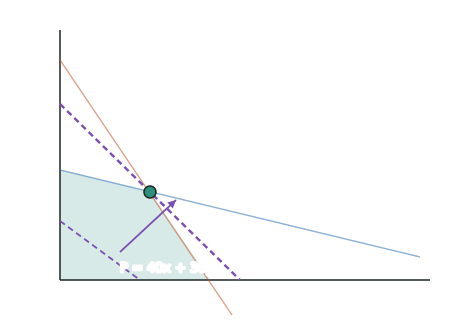
The Rotorua workshop's feasible region has vertices , , and . Profit is dollars, where = tables and = chairs. Find the production plan that maximises profit.
Step 1 — Set up the vertex test
The maximum sits at a vertex, so evaluate at each corner.
Step 2 — Substitute each vertex
Step 3 — Compare the values
The largest profit is $240, at the vertex .
Step 4 — State the plan in context
Test yourself
Practice by grade
One question each at Achieved, Merit and Excellence. Have a go, then compare with the model answer.
A feasible region has vertices , , and . The objective is . Test the vertices and state the maximum.
A courier minimises cost over a feasible region with vertices , , and . Find the minimum cost and where it occurs, and explain why you check the corners.
For the workshop ( tables, chairs; vertices ), the profit per chair is unknown: with . Find the range of for which making tables and chairs — vertex — gives the maximum profit.