Solving by substitution and elimination
What a system of equations is
- A system (or simultaneous equations) is two or more equations that must hold at the same time.
- The solution is the set of values that makes every equation true together — not just one of them.
- For two linear equations in and , each equation is a straight line, and the solution is the point where the lines cross.
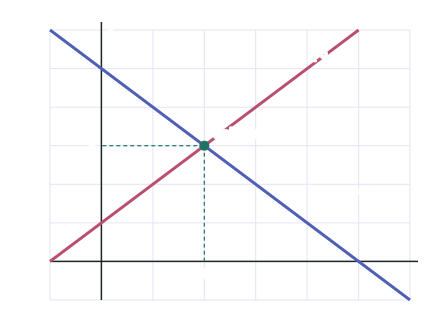
Method 1 — substitution
- Best when one equation already gives a variable on its own (like ).
- Rearrange one equation so a single variable is the subject.
- Substitute that expression into the other equation, giving one equation in one unknown.
- Solve it, then back-substitute to find the second variable.
Solve the system and .
Step 1 — Substitute the ready-made expression
The second equation gives . Put that into the first:
Step 2 — Solve for
Step 3 — Back-substitute for
Method 2 — elimination
- Best when the variables are lined up in columns (like ).
- Match the size of one variable's coefficient in both equations, multiplying an equation through if needed.
- Add or subtract the equations to eliminate that variable.
- Solve the result, then back-substitute.
Solve and .
Step 1 — Match a coefficient
Multiply the second equation by 4 so the -terms match:
Step 2 — Subtract to eliminate
Step 3 — Back-substitute
Choosing a method
- If a variable is already isolated (), reach for substitution.
- If both are in form, elimination is usually tidier.
- Either method gives the same solution — pick whichever needs the least rearranging.
Test yourself
Practice by grade
One question each at Achieved, Merit and Excellence. Have a go, then compare with the model answer.
Achieved
Solve the system and .
Merit
Solve and by elimination.
Excellence
Solve and by elimination, showing the method clearly and checking your answer.