How many solutions? The graph of a system
Three possibilities
- A system of two linear equations has one of three outcomes, and each has a clear picture:
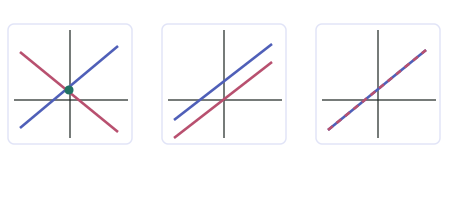
- One solution — the lines have different gradients, so they cross exactly once.
- No solution — the lines are parallel (same gradient, different intercept), so they never meet.
- Infinitely many solutions — the two equations describe the same line, so every point on it works.
Spotting the case from the algebra
- You do not need the graph — the elimination step tells you which case you are in:
- If you reach a normal value like , there is one solution.
- If both variables vanish and you get a false statement like , there is no solution.
- If both variables vanish and you get a true statement like , there are infinitely many solutions.
Solve and .
Step 1 — Subtract to eliminate
Step 2 — Read the result
This is false — no values of and can make it true. The lines have the same gradient but different intercepts (they are parallel).
Solve and .
Step 1 — Match and subtract
Multiply the first by 2: . Subtract the second:
Step 2 — Read the result
This is always true — the second equation is just the first one doubled, so they are the same line.
— every point on works.
Why it matters in context
- In a real problem, no solution means the conditions contradict each other (they cannot all be met).
- Infinitely many means one condition repeats another, so the problem is under-determined — you need more information to pin down a single answer.
Test yourself
Practice by grade
One question each at Achieved, Merit and Excellence. Have a go, then compare with the model answer.
Achieved
How many solutions does the system and have? Explain.
Merit
Show that and have infinitely many solutions.
Excellence
For what value of does the system and have (i) infinitely many solutions, and (ii) no solution?