Values, perceptions and responses
What the standard actually asks
- Explain how people's values and perceptions have led to their responses. The words that matter are led to — this is a causal claim, not a description.
- A value is what a group thinks matters: security, income, whakapapa, fairness, the environment, freedom to choose.
- A perception is how a group sees the situation: what they think the risk is, how urgent it is, who is responsible, what will happen if nothing is done.
- A response is what they actually do: submit, protest, sue, negotiate, build, sell, stay, leave, or say nothing.
- The chain is: values + perception → response. Write all three links, and the middle one is the one reports skip.
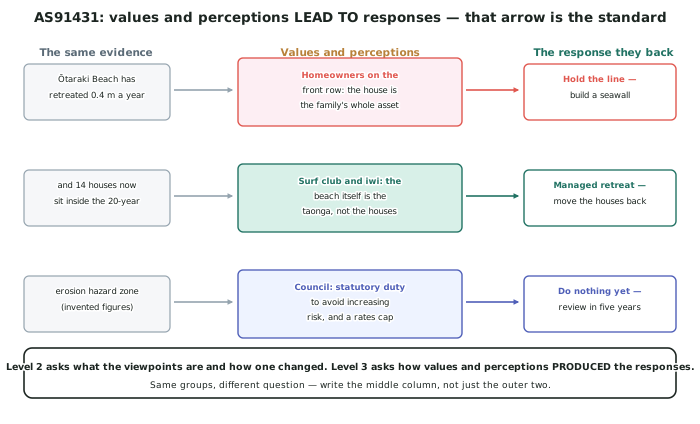
Why this is not the Level 2 standard
- AS91245 asks what the viewpoints are and how one viewpoint changed over time. That is description and history.
- AS91431 asks how values and perceptions led to responses. That is cause and effect, and it needs a mechanism.
- The practical difference: at Level 2, homeowners want a seawall is an adequate statement of a viewpoint. At Level 3 it is only the end of the chain, and you have to say what value and what perception produced it.
- Written properly: Homeowners' primary asset is a house that cannot be moved, and they perceive the retreat option as a transfer of their loss to them rather than a shared solution — so their response has been to submit against retreat and to argue for a wall, which is the only option that keeps value where their asset is.
- Test every group with the question: could I explain their response to someone who disagreed with them? If not, you have described a position rather than explained it.
Finding the values behind a response
- Ask what the group depends on. Homeowners depend on a fixed asset; the surf club depends on the beach existing; the council depends on a rate take and a statutory duty.
- Ask what they stand to lose, and whether they can move it. This single question explains most coastal-hazard disputes: a house cannot move, a memory cannot move, and a rate bill can be spread.
- Ask what their history is. A community that has been through a previous consultation and felt ignored responds differently to the next one, and saying so is explanation rather than speculation — provided you have evidence.
- Ask what worldview the group's language reveals. Property rights, kaitiakitanga, statutory obligation, the coast will always win — each is a window into a set of values.
- Never reduce a value to self-interest alone. People holding the same interest can respond differently, and the difference is the perception.
Perceptions, and why the same evidence divides people
- Perception is how the evidence is read, and it is where two groups with similar values still diverge.
- In the invented Ōtaraki case, the retreat rate of 0.4 m a year is read three ways: as slow enough that a wall will outlast us; as fast enough that 14 houses are already inside a 20-year line; and as an average that hides the storm which will take five metres in a night.
- All three readings are compatible with the number. That is why more data has not resolved the issue.
- Use one piece of evidence read three ways — it is the fastest demonstration of perception in a report.
- Note where perceptions have changed, because changed perception is often what makes an issue contemporary. The 2023 hazard map changed nothing physical and changed the perception of urgency for everyone.
Documenting responses
- Responses are actions, and actions leave evidence: submissions, petitions, media statements, meeting attendance, legal action, property sales, insurance decisions.
- Quantify them. 62 submissions against retreat, 41 in favour, of which 29 came from outside the affected street is a finding; the community was divided is not.
- Include the group that did not respond. Silence is a response, and the reasons for it — no time, no standing, no expectation of being heard — are worth explaining.
- Distinguish the response from the rhetoric. What a group says in a submission and what it does with its property may differ, and a difference between the two is worth noticing.
- Interviews are gold here. One conversation with a resident, a councillor and a surf club officer will give you the causal links the documents leave out.
Worked Example
Worked example
Explain how the values and perceptions of ONE group have led to their response to a contemporary geographic issue.
The group chosen: mana whenua at the invented Ōtaraki Beach.
Answer:
Step 1 — state the values, and be specific about their source.
Mana whenua hold the dune system and the beach as a taonga and as a site of mahinga kai, with a whakapapa connection to the coastline that predates the street behind it. The value at work is kaitiakitanga — an obligation to leave the place in a state that future generations inherit intact. This is an obligation, not a preference, which matters for what follows.
Step 2 — state the perception, and show how it differs from the others' reading of the same evidence.
The same 0.4 m a year retreat rate is read here not as a threat to the coast but as the coast behaving normally. On this reading, what is out of place is the row of houses built on an active dune system within the last 70 years, and the erosion is not a problem to be solved but a process that the built environment failed to allow for.
Step 3 — connect the two to the response, which is the marked link.
Because the value is an obligation to the system rather than to any structure on it, and because the perception is that the system is functioning, a seawall is not a compromise from this position — it is the one option that permanently damages the thing being protected, since reflected wave energy scours the beach in front of it. That is why the response has not been to seek a share of the defence but to oppose defence altogether and to support managed retreat, and why offers of a partial wall have been rejected rather than negotiated.
Step 4 — evidence the response with what was actually done.
Mana whenua lodged a submission opposing all hard-defence options, sought involvement in the design of any retreat alignment, and — significantly — did not oppose the do-nothing option, which no other group supported. That last fact is the strongest evidence about the underlying value: an option that saves nobody's house is acceptable if it leaves the system free to move.
Step 5 — say what this predicts, which is what makes it an explanation.
If the analysis is right, this group's position should be insensitive to cost, because the objection is not economic. It is: the $4.6 m wall and a hypothetical cheaper wall have both been opposed, while the $7.2 m retreat — the most expensive option on the table — has been supported. A group whose position does not move with price is telling you their value is not a price.