Proposing and justifying a course of action
The countable requirement
- The standard says the justification includes consideration of at least ONE alternative solution. That is a requirement, not a suggestion, and it is checked.
- At Merit the justification must demonstrate why your choice is better than the alternatives — so one alternative is the floor, and two or three make the comparison far stronger.
- At Excellence you need a full justification showing insight, described in the standard as an in-depth response that uses clarity of argument and holistic understanding.
- Consideration means genuine consideration. An alternative dismissed in one sentence has not been considered; it has been mentioned.
- Give each alternative its best case before you reject it. A justification that only defeats weak versions of the alternatives is not a justification.
Building the comparison
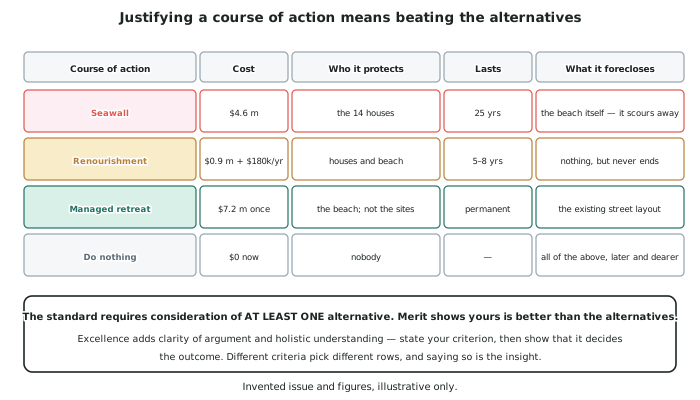
- Set out the realistic options. In the invented Ōtaraki case there are four: seawall, beach renourishment, managed retreat, and do nothing for now.
- Compare them on the same criteria, and say what the criteria are before you apply them. Useful ones here: cost, who it protects, how long it lasts, and what it forecloses.
- A table is the clearest way to do this, and it makes gaps in your research obvious.
- Include "do nothing". It is always an option, it is usually the cheapest, and comparing against it is what shows the others are worth their cost.
- Cost is not one number. Distinguish the capital cost, the ongoing cost and who pays: a $4.6 m seawall and a $0.9 m renourishment plus $180,000 a year cross over after about 20 years.
What makes a justification, rather than a preference
- State your criterion before you use it. I am judging these options on what they leave possible in fifty years is a criterion; I think retreat is best is a preference.
- Show that the criterion decides the outcome. The strongest justifications demonstrate that a different criterion would select a different option — and then defend the criterion, not just the choice.
- Deal with the strongest objection to your choice, not the weakest. If your proposal is retreat, the strongest objection is that it imposes the largest immediate cost on people who did nothing wrong, and it has to be answered.
- Say who bears the cost of your proposal, and whether that is defensible. A proposal that is efficient and unfair is not automatically better than one that is fair and expensive.
- Be specific about implementation. Who does what, over what period, funded how. A proposal with no mechanism cannot be evaluated.
Making the proposal geographic
- Your proposal should depend on the geography, or it is a policy essay with a place name attached.
- In the invented case, the sand supply from a river 12 km north and the southward drift are what rule out a wall as a long-term answer — the beach in front of a reflective structure narrows.
- Say what would change your proposal. If the sand supply were stable and there were no drift, a wall would be defensible, and this recommendation would change is a mark of a properly grounded argument.
- Use the spatial dimension in the design. A staged retreat that moves the 14 properties inside the 20-year line first, and the 38 later, is a proposal shaped by the map.
- Include the map in the report and refer to it in the justification.
Holistic understanding, which is the Excellence word
- The standard describes Excellence as clarity of argument and holistic understanding. Holistic means the proposal accounts for the whole system rather than one part of it.
- Three things to show: that your proposal works physically, that it is fundable, and that it deals with the groups whose values it disappoints.
- Acknowledge what your proposal costs the losing side. A recommendation that pretends there is no losing side is not holistic; it is optimistic.
- Connect back to the values analysis. If a group's value is immovable, your proposal must either convert it into another form or explain why it cannot be accommodated.
- End with limits. This recommendation holds while the sand supply continues; if the river's sediment load were to change, the comparison between renourishment and retreat would need redoing.
Worked Example
Worked example
Propose a course of action for the invented Ōtaraki Beach issue and justify it, considering at least one alternative.
Answer:
Step 1 — state the criterion first, and defend it.
I am judging these options on what they leave possible in fifty years, because the retreat rate of 0.4 m a year means the situation continues to change after any decision, and an option that solves the next twenty years by making the following thirty impossible is not a solution. Cost matters, but it is a constraint rather than the criterion, because all four options are within the district's borrowing capacity.
Step 2 — set out the options against that criterion.
- Seawall, $4.6 m. Protects the 14 houses for about 25 years. Forecloses the beach: on a drift-fed coast, reflected wave energy scours the sand in front of a wall, and the beach that draws 60,000 visits a year narrows and eventually disappears. It also forecloses retreat, because once a wall is built the properties behind it become harder to relinquish.
- Renourishment, $0.9 m plus $180,000 a year. Protects the houses and the beach. Forecloses nothing, but never ends: after 25 years it has cost more than the wall and the problem is unchanged.
- Managed retreat, $7.2 m once. Protects the beach system, not the sites. Forecloses the existing street layout, permanently.
- Do nothing. Forecloses all of the above later and more expensively, since each year of erosion narrows the options and raises the cost of every one of them.
Step 3 — make the proposal, with a mechanism.
I propose a staged managed retreat, using the map to sequence it: voluntary purchase of the 14 properties inside the 20-year line over five years, with the road and services realigned landward at the same time; the 38 properties inside the 50-year line placed under a no-rebuild designation, with purchase offered as each reaches a 20-year exposure. Renourishment continues in the interim at $180,000 a year to hold the beach while the first stage is completed.
Step 4 — show why it beats the alternatives on the stated criterion.
The wall fails the criterion outright: it buys 25 years and permanently removes the beach, which is the asset with no substitute. Renourishment passes the criterion but never resolves anything — in fifty years the district has spent about $9.9 m and faces the same decision with less time. Retreat is the only option that ends the problem rather than deferring it, and staging it spreads the $7.2 m across two decades rather than one budget.
Step 5 — answer the strongest objection to my own proposal.
The strongest objection is not cost; it is fairness. The 14 households did nothing wrong, bought lawfully, and would bear a loss that the district's decision crystallises. Voluntary purchase at pre-2023 market value answers most of that, because it converts the loss into a transfer that the whole district funds — which is why the mechanism matters as much as the choice. What it cannot answer is that a house is not only money, and my proposal does impose a real loss on the people least able to avoid it. I am recommending it anyway, and saying so plainly is part of the justification.
Step 6 — state the limits.
This recommendation depends on the sand supply from the river 12 km north continuing. If that supply failed, renourishment would become unviable and the comparison would change, though it would strengthen rather than weaken the case for retreat. It also depends on purchase being voluntary; a compulsory scheme would change the fairness analysis entirely and I would not support it on this evidence.