The four aspects of a written text
Analysing an aspect
- Analysing a written text means taking one aspect of it and showing what that aspect does — the meanings and effects it creates in a reader.
- An aspect is one dimension of the text, not the whole text. Four categories cover them: purposes and audiences, ideas, language features and structures.
- Each aspect is tied to an effect. Analysis is never complete at the point you have shown a choice was made — it is complete when you have shown what the choice did.
What the key terms cover
- The terms are wider than they look, and each covers more than its everyday meaning.
- Setting covers physical places as well as social and historical contexts.
- Ideas covers character, theme or setting, so an idea can be traced through a single character.
- Structure covers the order, organisation or conventions of a text.
- A text set in an ordinary suburb still has setting worth analysing — the social world of that suburb is setting.
Aspect and effect
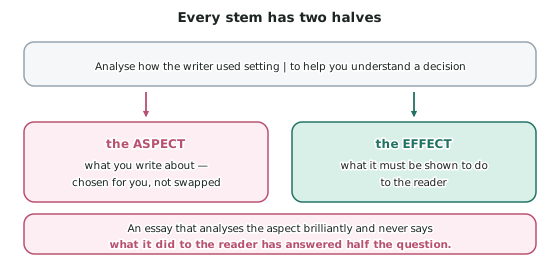
- Both halves belong in the thesis. Analysis of an aspect that never reaches an effect on the reader is only half an analysis.
Three demands an essay has to meet
- Analyse means explore and interpret how meanings and effects are created — not describe them. Every paragraph has to say what a choice does, not just that it was made.
- Reasoned and clear is the next demand on top of that. Each interpretation is argued from the words rather than asserted, and the majority of them connect to each other instead of sitting side by side.
- Insight or originality is the last, and it is not more of the first two. A thorough essay that says only obvious things has met the first two and stopped.
- These three demands run through the rest of this topic without being restated.
The four aspect categories
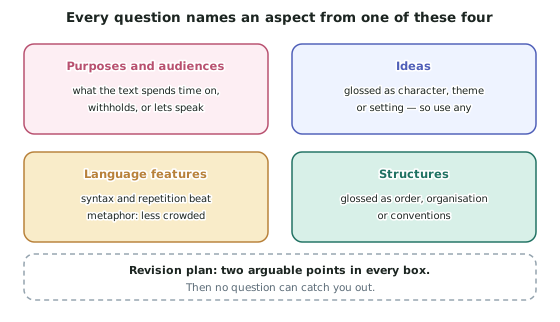
- The categories overlap, and that is allowed. A symbol is a language feature; what it symbolises is an idea; where it appears is structure. Keep the named aspect in charge of every paragraph, and cross into the others only as support.
- An idea is not a topic. Family is a topic. That loyalty to a family can require dishonesty toward it is an idea, because it can be disputed. Turn every topic into a proposition, or the essay will describe rather than analyse.
- Structural claims are often the most original, and frequently need no quotation at all. Have ready: where the text begins; where it ends, and whether the ending returns to the opening; the order of events against the order they happened; what is withheld, and for how long.
Worked Example
The extract below was written for this page, so it can be quoted freely.
Every morning for eleven years Whetū had taken the six-fifteen across the harbour, and every morning she had sat on the left-hand side, where you could see the cranes. The new ferry had no left-hand side worth the name — the seats faced forwards in rows, like a bus, like a plane, like anywhere. On the first morning she stood at the rail instead, in the wind, and was the only one. By the second week there were four of them. Nobody said anything to anybody. They simply stood, in the cold, facing the cranes, while inside the warm cabin the rows of headrests went past the port without turning.
Show how the same extract answers a question from each of the four categories.
Answer: the material does not change. What changes is what the paragraph is in charge of.
Purposes and audiences — Analyse how the writer positioned you to judge a change.
The text never says the new ferry is worse. It arranges the judgement: the old routine is given in habit and duration — "eleven years", "every morning" — the new one in a comparison ending in nothing, "like a bus, like a plane, like anywhere".
Ideas — Analyse how an idea was developed through a character.
The idea is that attention is a choice most people have stopped making. Whetū does not protest; she stands. The count — "the only one", then "four of them" — makes a private preference spread.
Language features — Analyse how language features were used to sway your emotions.
The triple "like a bus, like a plane, like anywhere" degrades as it goes, ending on a word that names no place, so the sentence performs the loss it describes. The final clause gives its last position to "without turning" — a phrase about the port, and about the passengers.
Structures — Analyse how the ending of a text developed an idea.
The extract ends on the people who are not its subject: the final clause pulls back to the "rows of headrests". The structure withholds any statement of meaning and stops at the image.