Choosing a section, and the multi-pass method
What the standard asks for
- Close viewing and listening is the detailed examination of a small amount of visual or oral material. The question moves from what happens in this text to what is happening in these ninety seconds.
- The verb is analyse. You explain how meaning is made, not what the text is about. A retelling with technical words attached is still a retelling.
- Supported by evidence is in the title, and evidence here is a timecode plus a precise description — never a remembered impression.
- Do not submit a whole-text essay. It is the commonest structural mistake: the student writes about the film, mentions the section once, and never gets closer than a paragraph of summary.
The original-form rule
- Visual texts — film, short film, documentary, television programme, advertisement, music video, animation, news bulletin, title sequence. Oral texts — a speech, radio documentary, podcast, recorded interview, oral performance, talkback.
- The title says visual and/or oral, so a text with no image at all is fully in scope and is often the better choice: almost every student submits film, so sound-only work is less crowded.
- The EN requires the text in its original form, which rules out three things.
- A transcript. It keeps the words and discards timing, pause, layering, delivery and image — everything being assessed.
- A written description, for the same reason. You may write one from the text; you may not work from one.
- A still image. A still has no duration, and duration is where most of your evidence comes from.
- So you need a copy you can replay yourself, ten or more times.
Choosing the section
- Choose about 60 to 120 seconds, or up to three minutes of an oral text, because speech carries less per second than image and sound together.
- The test: you should be able to watch or listen ten times in under an hour with a log open. Too much material forces summary, and description earns nothing at any grade.
- Choose a section that is doing something. Four kinds reward close attention: a turning point; a first appearance, where every choice decides how you read what follows; an ending, because endings are where a text says what it thinks; and a moment where the channels disagree — the music wrong for the picture, the smile wrong for the line. The last is the richest kind available.
- Count the channels making decisions: image, editing, score, silence, performance. This is the criterion students skip and the one that sets the ceiling.
- Say where the section sits in the whole text, in one or two sentences. The EN names part text as a structure, and it costs two lines.
The grade ladder for this standard
- Achieved — analyse aspects. Explain how meaning is created in the section, and support each point with evidence.
- Merit — convincingly. Reasoned and clear, and showing how significant aspects work together to create meaning. That clause is unique to this standard, so a submission analysing camera, then sound, then editing — each correctly and separately — has not met it.
- Significant does the other half: the aspects must govern the meaning, not decorate it. The test is removal — take the aspect away, and does the meaning change or only the texture?
- Excellence — perceptively. Insightful and/or original. Correct decoding of a convention is not insight, because the maker relied on you decoding it.
- The choice you make on this page constrains all three. A section with only one channel doing anything cannot show aspects working together, so it caps at Achieved however well it is written.
Why one viewing finds almost nothing
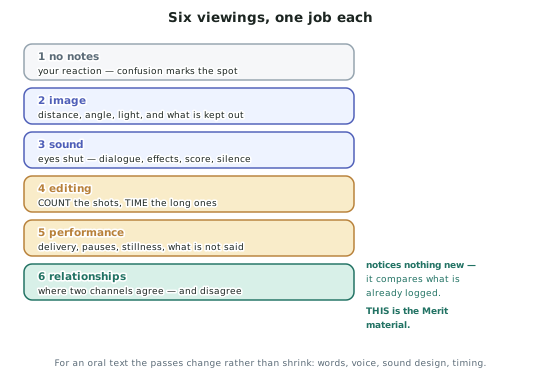
- A visual text is simultaneous. Image, cutting, dialogue, score and performance arrive in the same second, and attention cannot cover them at once — so it follows the story instead, which is the one level the standard does not reward.
- For an oral text the passes change rather than shrink. Pass 2 becomes words, pass 3 voice (pace, pitch, volume, stress, pause, breath), pass 4 sound design (room tone, effects, music, layering), pass 5 timing and editing. Passes 1 and 6 are unchanged.
The shot log, and numbers as quotations
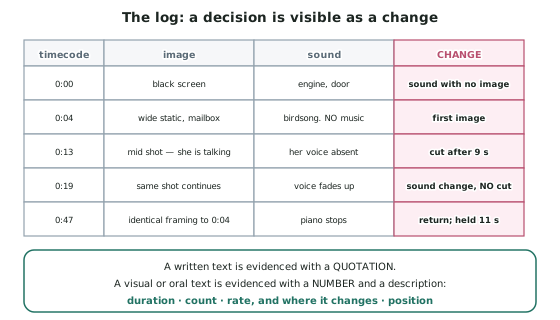
- Keep the log while you work, not afterwards.
- Log a row for every shot, plus one for every sound event that does not coincide with a cut, and log absences too — no score, no reverse shot. Ninety seconds usually gives 15 to 40 rows.
- Almost no student provides numbers, so they are the cheapest way to be precise and look precise at once. Round honestly — about nine seconds is fine, a fake 8.7 seconds is not.
Reading the log for the shape of the section
- Structures is one of the four aspect categories, and the least crowded, because students assume structure belongs to whole texts.
- Divide the section into movements first. Most have two or three, and the boundaries are countable: a change in cutting rate, the entry or exit of music, a change of place or speaker. Name each and give it a duration, then read the proportions — time given to one thing rather than another is an argument about priority.
- Two structural devices are worth hunting for in the log.
- Return — a framing, sound, line or gesture appearing twice. A return with something changed is the strongest single device a short section can contain: the sameness tells you to compare, the difference tells you what to conclude.
- Pattern and break — a habit established, then abandoned. The break is where the meaning usually is, and most candidates analyse the habit.
Worked Example
Worked Example
A completed log for "The Last Delivery", a 1:09 documentary sequence written and described for this topic — the closing sequence of a documentary about a rural mail run.
| Time | Image | Sound | Change |
|---|---|---|---|
| 0:00 | Black screen | Engine idling, handbrake, door | Sound with no image, 4 s |
| 0:04 | Wide static, mailbox on gravel road, low morning light | Birdsong, van idling. No music | First image; camera static |
| 0:13 | Mid shot, Raewyn in the van. She is talking | Van only. Her voice absent | Cut after 9 s |
| 0:19 | Same shot continues | Voice fades up mid-sentence | Sound change with no cut |
| 0:24 | Close-up, her hands on the wheel | Piano begins | Cut; first music |
| 0:28 | First of eleven short shots | Piano continues; no dialogue | Cutting rate jumps |
| 0:47 | Identical framing to 0:04. Van exits | Piano stops. Birdsong. Held 11 s | Return; score exit |
| 0:58 | Mid shot: Thirty-one years. Pause. It's just a road. | Speech only | Only line of speech |
| 1:06 | Cut to black | Birdsong continues 3 s | Image ends before sound |
Using the log, state the section's shape and give two findings that no single viewing could produce.
Read the Time column first, because durations are the fastest pattern to find. The opening runs at about nine seconds a shot; from 0:28 eleven shots arrive in nineteen seconds, one every 1.7 seconds. That jump is a boundary, and a second sits at 0:47, giving three movements: introduction 28 s, montage 19 s, aftermath 22 s. Note the proportions — what is left when the job ends takes longer than the job.
Finding 1 — a return with a subtraction. The framing at 0:47 is identical to 0:04, so the analysis is about what has changed inside it: the van is idling at 0:04, and at 0:47 it leaves and does not come back, with the shot held eleven seconds on an empty road. In real time this registers as a nice shot at the end; only the log shows it is the same shot.
Finding 2 — a sound change placed off a cut. At 0:19 her voice fades up mid-sentence, six seconds after we first see her speaking. Cuts and sound changes normally coincide, so one placed away from a cut is a decision — and the ear accepts the voice as soon as it arrives, so this passes unnoticed at normal speed.
Then check the two ends against each other. The sequence opens with 4 seconds of sound and no image and closes with 3 seconds of birdsong over black — the same device reversed, and the reversal is invisible until the first and last rows are put side by side.