Purposes, ideas, and the language features
The four aspect categories
- The EN gives the same four categories as AS91099: purposes and audiences; ideas (character, theme, setting); language features; and structures.
- Most submissions use language features only. That is legal, and it is crowded.
Purpose and audience in a short section
- Purpose is what the text wants from you, and a section has its own local purpose which need not match the whole text's: a documentary informs, but its final ninety seconds may be marking a loss.
- Purpose is evidenced by choices, not by subject matter.
- What is explained and what is assumed. A text that defines nothing has decided its audience already knows.
- Where the text stops. An ending that withholds the outcome wants you unsettled; one that resolves wants you reassured.
- How much time is given to what. Twenty-four seconds on the situation and three on the product is a statement of priorities, and it is countable.
- Find the moment the purpose switches. Many texts run one purpose and hand over to another at an identifiable second, and that second is strong evidence.
- Audience is evidenced from the text, not guessed from the topic. Everything left unexplained is knowledge the text expects you to have; who is in the frame or the recording addresses someone; and register tells you what state the listener is assumed to be in. Never write the audience is teenagers with no evidence — name the choice that narrows the audience, then state who is excluded by it.
Ideas: character, theme and setting
- An idea is a statement with a verb. Loss is a topic; the section presents loss as the removal of a routine is an idea.
- Character in ninety seconds is behaviour, not biography — what someone does with their hands, what they look at, what they do not say. Look for the one moment they stop: stillness inside activity is where character is usually located.
- Theme is what the section argues, and it is normally carried by a structure rather than by dialogue: a repetition, a proportion, an ending.
- Setting is a set of decisions, not a place — what is in the frame or the room tone, how it is lit or recorded, and what is kept out. Objects are chosen.
- Evidence an idea the same way as anything else — a timecode, a duration, a count. The final framing repeats the opening framing with the van removed evidences an idea about loss without any adjective.
The image: camera and production design
-
Every feature is only analysable as a decision — naming it is not analysis; saying what the choice does, and what the ordinary alternative would have done, is.
-
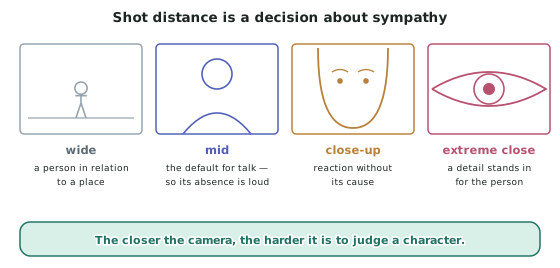
Shot distance decides how much context you are given. A close-up removes the room, so a reaction arrives with no visible cause; a wide keeps the cause in frame and makes you choose where to look.
-
Angle, movement and focus. A static camera makes you wait; a move draws a line between two things; shallow focus decides what is allowed to be sharp. Framing is exclusion — ask what has been kept out.
-
Lighting is a source and a direction. One low window at the left leaves a permanent shadow on the right, and every action then happens in relation to that unlit space.
-
Production design is a set of chosen objects. A stripped bed, a coiled heater cord, a bus timetable pinned above a mattress: each states something about how a place was used and left.
The cut and the soundtrack
- Editing is analysed with numbers. Count the shots, time the long ones, find where the rate changes; a cutting rate that halves is an event. A held shot is an editing decision too — seventeen unbroken seconds of an ordinary task shows it at its real duration instead of compressing it.
- Sound has four layers, and most submissions analyse one.
- Dialogue — including whether there is any at all.
- Effects and room tone — the sound of the place, which is a setting choice made in the edit.
- Score — where it starts, where it stops, and what it is attached to. Music that begins under one activity and ends with it is attached to that activity, not to the place or the person.
- Silence — timed, never described.
The person: performance, voice and rhetoric
- Performance is analysed in what is withheld — a held expression, a delay before answering, a look not acted on — and in what runs against the obvious choice, such as dropping volume under the hardest line rather than raising it.
- Pauses must be timed and located. A pause between sentences is punctuation; a pause inside one is the person still choosing, and usually the only place you hear someone think.
- In an oral text, microphone distance does what shot distance does. A voice recorded closer at one point has been brought nearer without a word being said about it.
- Rhetorical devices are structures in speech — repetition, triples, contrast, direct address, the rhetorical question. Analyse the placement, not the label.
- The strongest performance point is a mismatch. A smile after a bleak line, or a calm voice delivering an accusation, satisfies the Merit requirement in one sentence.
Worked Example
Worked Example
"The Night Line" — a radio documentary segment, written and described for this page. No image at any point. Treat it as a section of a studied radio feature about a volunteer phone service.
- 0:00 — Room tone only, 4 seconds: a heater ticking, a clock.
- 0:04 — Narrator, studio acoustic, close and clean: The room is upstairs, above a bakery that closed in 2019.
- 0:11 — A different acoustic, larger and echoing. Marama, mid-sixties, not close to the microphone: You get the first one about eight. Then it's steady.
- 0:19 — A phone rings in her acoustic. That'll be one now.
- 0:24 — The tape is cut. Studio tone returns. Narrator: We agreed not to record the calls.
- 0:30 — Six seconds of the upstairs room: heater, clock, and a voice too quiet to make out.
- 0:36 — Marama, closer to the microphone now: Sorry. Pause, 2 s. That one was fine.
- 0:48 — Marama, quieter than at any earlier point: You do not fix it. Pause, 3 s. You just make it later.
- 0:57 — Music enters for the first time: one low sustained note under the room tone.
- 1:02 — Room tone alone, 5 seconds. Segment ends.
Analyse how sound and performance work in this segment.
Start with the acoustics, because in an audio text they are the setting. Two rooms: the narrator close and clean with no reverb; Marama in a larger echoing space, not near the microphone. One voice was constructed and one was visited — the narrator explains the place, Marama is in it.
Then track microphone distance, because it moves. Distant at 0:11, closer at 0:36, with nothing in the words to mark the change. The segment becomes intimate exactly where it stops being about the job and starts being about her: proximity does what a close-up would do, and it has a timecode.
Now the pauses, timed. The 2 s pause at 0:36 sits between an apology and a reassurance — she is deciding how much to say about a call we were not allowed to hear. The 3 s pause at 0:48 is the longest in the segment and falls inside her own sentence, which is the person still choosing rather than punctuating. And she is quieter there than anywhere else, running against the obvious choice of emphasis and making the listener lean in.
Now the editing, which is audible. At 0:24 the tape is cut and the narrator's explanation lands immediately after the phone rings, so the cut and its reason arrive together. Then the strangest decision: six seconds of the room with a voice deliberately left too quiet to make out — the piece has just said it will not record the calls, then records one being taken with none of the words. The absence is constructed, not missing tape.
Finally the music. The single note arrives at 0:57, after the key line rather than under it: withheld for nearly a minute, then added once the meaning has landed, so it confirms rather than steers. The segment then ends on five seconds of the room tone it opened with.