Comparing causes and comparing groups
Why an issue's causes have to be weighed against each other
- Most economic issues have causes on both sides of the market — something moved demand, and something limited supply.
- Listing them side by side leaves the important question unanswered: which one is producing the outcome people are complaining about?
- That question is not academic. The cause that drives the outcome is the one that has to be acted on, so weighing the causes is what turns a description of an issue into an argument about what to do.
What makes one cause more important than another
- Compare causes by their effect on the issue itself, using four tests:
| Test | The argument |
|---|---|
| Size of the shift | Which cause moved its curve further? |
| Direction and severity | Demand shifts set direction; inelastic supply sets severity |
| Persistence | A permanent cause outweighs a temporary one |
| Tractability | Which one can actually be acted on? |
"Both causes raised the price. But the demand shift determined the direction, whereas the inelastic supply determined the severity — because with supply nearly fixed, almost the entire adjustment had to fall on price rather than quantity. The supply constraint is therefore the more important cause, and it is also the one that persists after the demand surge ends."
Direction and severity — the distinction that does most of the work
- A demand shift sets the direction of the price change. More buyers at every price means the price must rise; fewer means it must fall.
- The elasticity of supply sets how far the price moves. The same rightward demand shift produces:
- a small price rise and a large quantity rise against elastic supply, because sellers respond by producing more
- a large price rise and a small quantity rise against inelastic supply, because sellers cannot produce much more, so the market can only clear by rationing through price
- This is why two markets hit by identical demand shocks produce completely different issues. Nobody writes a report about a market where supply responds.
Comparing the groups an issue affects
-
Choose two groups whose interests differ, and build the comparison in four moves:
- The similarity — usually that both are affected by the same price movement.
- The difference in direction — one gains, one loses.
- The difference in severity — relative to income, options and buffers.
- The judgement — who is worst affected, with reasons.
-
The strongest pairs sit on opposite sides of one price: buyers and sellers, renters and landlords, consumers and producers. Their outcomes are then strictly linked — every dollar one pays is a dollar the other receives — so the comparison is about one movement, not two unrelated effects.
Reading the model into the sentences
- A diagram on one page and an explanation elsewhere that never mentions it are two separate pieces of work.
- Write so that the model's labels appear inside the sentences, and the diagram and the argument become the same claim in two forms.
"Population growth increased the number of households seeking rentals, so demand shifted right from D to D1. Against a steep supply curve, the equilibrium rent rose sharply from Pe to Pe1 while quantity rose only slightly from Qe to Qe1 — so the extra dwellings supplied are far fewer than the extra households, and the households who could afford Pe but cannot afford Pe1 drop out along the original demand curve D, priced out of the market entirely."
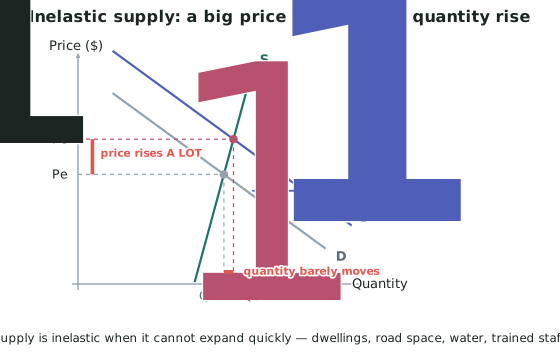
- The test: cover the diagram. If the explanation reads the same, the model is not integrated.
Why the comparison cannot be tacked on at the end
- A comparison needs two things to compare, and that is settled by the work done before any writing starts.
- One cause cannot be weighed against itself, and one group's experience says nothing about whether it is severe.
- So the choice that decides whether an issue can be analysed at all is made early: two causes, one from each side of the market, and two groups with opposing interests.
- The four-box test. Before writing, name: cause 1 (demand side), cause 2 (supply side), group 1, group 2. An empty box means there is nothing to compare, and no amount of writing later will fill it.
Worked ExampleTurning a bare paragraph into an analysis
A student has written:
"The main causes of rising rents were population growth and a lack of new houses being built. This affected renters, who had to pay more, and landlords, who earned more."
Rewrite it so it does the analysis.
Step 1 — Diagnose
The paragraph names two causes and two groups — the raw material is right — but it has:
- No model. No curve shifts, no labels.
- No detail. The mechanisms are not explained.
- No comparison of the causes, and none of the groups.
- No judgement.
Step 2 — Cause 1, with the model integrated
Step 3 — Cause 2, with the model integrated
Step 4 — Compare the causes — the first analytical move
Step 5 — Impacts on both groups, in detail
Step 6 — Compare the groups — the second analytical move
Step 7 — Count what was added
| Component | Before | After |
|---|---|---|
| Models with labels | none | D→D1, Pe→Pe1, Qe→Qe1 used in sentences |
| Detail | none | mechanisms for both causes and both groups |
| Comparison of causes | none | direction vs severity, with 2 reasons |
| Comparison of groups | none | similarity, contrast, judgement |