Solving trigonometric equations
Why there are always many solutions
- Trigonometric functions repeat, so an equation such as has infinitely many solutions.
- The calculator gives you only one — the principal value from the inverse function. Every other solution must be found by reasoning.
- The principal value ranges:
- returns an angle in
- returns an angle in
- returns an angle in
Where the other solutions come from
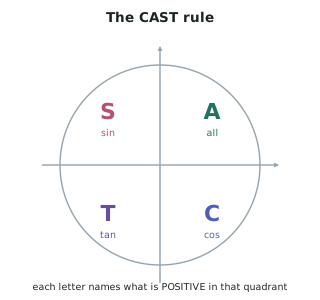
- The CAST rule records where each function is positive, reading anticlockwise from the fourth quadrant:
- C — 4th quadrant: cos positive
- A — 1st quadrant: all positive
- S — 2nd quadrant: sin positive
- T — 3rd quadrant: tan positive
- Within one revolution , each equation has two solutions (unless the value is exactly at a maximum, minimum or zero):
| Equation | Solutions in |
|---|---|
| and | |
| and | |
| and |
where is the principal value (adjusted into the interval if negative).
- Tangent is the exception: because its period is , its solutions are apart, not paired symmetrically.
The method
-
Isolate the trigonometric function so it stands alone.
-
Find the principal value with the inverse function.
-
Use the CAST rule or a sketch to find the other solution in one revolution.
-
Add or subtract multiples of the period to fill the required interval.
-
Check every solution lies inside the stated interval, and that none is missing.
-
Worked through — solve for :
- Isolate:
- Principal value:
- Sine is positive in quadrants 1 and 2, so the second solution is
- Solutions:
When the value is negative
- A negative value shifts which quadrants apply.
- For on :
- — the calculator already returns a second-quadrant angle
- Cosine is negative in quadrants 2 and 3, so the other solution is
- Sketching the curve and drawing the horizontal line shows immediately how many intersections there are and roughly where.
Equations with a multiple angle
- For on , the argument runs from to — three full revolutions.
- The method:
- Widen the interval for the argument: if , then .
- Find every solution for in that widened interval.
- Divide each by 3 at the end.
- This is where solutions get lost. A multiple angle multiplies the number of solutions, so has six solutions in one revolution of , not two.
Quadratic trigonometric equations
- An equation such as is a quadratic in .
- Substitute , factorise, then solve each resulting equation separately.
- gives or , and each is solved as usual.
- Reject any value outside for sine or cosine — it has no solution.
Using an identity first
- If an equation contains two different functions, use an identity to reduce it to one.
- becomes, using :
- , so
- Factorise rather than dividing, so no solution is lost.
Worked ExampleAn equation with a multiple angle
Solve for , giving exact answers.
Step 1 — Isolate the trigonometric function
Step 2 — Widen the interval for the argument
This is the step that decides whether the answer is complete. Since
multiplying throughout by 3 gives
Step 3 — Find the principal value
Step 4 — Find the second solution in the first revolution
Cosine is negative in quadrants 2 and 3. The principal value is in quadrant 2; the quadrant-3 partner is
So in : and
Step 5 — Extend across all three revolutions
Add and then to each, keeping only values up to :
From :
From :
Check they all lie in . Since , the largest value is inside ✓ and adding another would give , so we have them all.
Six values of , as predicted.
Step 6 — Divide every value by 3
Step 7 — Check the answers are in range
The largest is , and ✓ all six lie in .
Step 8 — Verify one solution
Taking :