Three planes, and systems containing an unknown constant
Every equation is a plane
- is the equation of a plane in three-dimensional space.
- A solution of the system is a point lying on all three planes at once.
- The nature of the solution is exactly the geometry of how the three planes are arranged, which is why the geometric picture is worth knowing rather than just the algebraic signatures.
The configurations
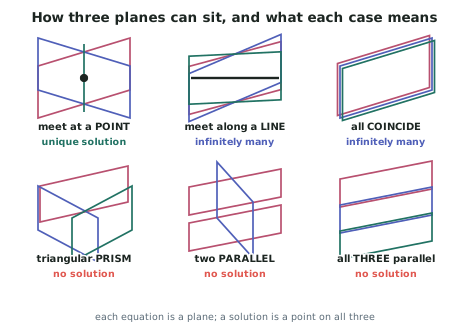
| Configuration | Solutions | How to recognise it |
|---|---|---|
| Meet at a point | Unique | three independent equations |
| Meet along a line ("sheaf") | Infinitely many, 1 parameter | one equation is a combination of the other two |
| All three coincide | Infinitely many, 2 parameters | two equations are multiples of the third |
| Triangular prism | None | each pair meets in a line, but the three lines are parallel and distinct |
| Two parallel, one crossing | None | two equations have proportional coefficients but non-proportional constants |
| All three parallel | None | all three have proportional coefficients, different constants |
- The prism is the subtle case. Every pair of equations is perfectly consistent — you can solve any two of them — but no point satisfies all three. It is the geometric picture behind "the pieces all agree, but not together".
Reading the coefficients
- Proportional coefficient rows mean parallel planes:
- and have coefficients in the ratio but constants and , which is not — parallel and distinct, no solution.
- If the constant had been , the whole rows would be proportional — the same plane.
- Check the constant separately from the coefficients. The coefficients decide whether the planes are parallel; the constant decides whether they coincide.
Systems containing an unknown constant
- A standard Excellence question: for what values of does the system have a unique solution, infinitely many, or none?
- The strategy is always the same:
- Eliminate normally, carrying along as an ordinary symbol.
- Reduce to a single equation of the form .
- Then read off the three cases:
| Final equation | Condition | Outcome |
|---|---|---|
| whatever is | Unique solution | |
| and | Infinitely many | |
| and | No solution |
- Do not divide by an expression containing . Dividing by silently assumes — which is exactly the case the question is about.
- Solve first, then test each root in . That is what separates the "infinitely many" values of from the "none" ones.
Interpreting the answer in context
- Unique — the information given pins the situation down exactly.
- Infinitely many — the information was not enough; one of the conditions repeated another. In context: "the third measurement told us nothing we did not already know."
- None — the conditions contradict. In context: "the specification cannot be met; conditions 1 and 3 are incompatible."
- Say which is which and why, in the context's own language. That is the interpretation the standard is assessing.
Worked ExampleA system with an unknown constant
For what values of does the following system have (i) a unique solution, (ii) infinitely many solutions, (iii) no solution? Interpret each case geometrically.
Step 1 — Eliminate from the first pair
:
Expand the subtraction in full:
Step 2 — Eliminate from a different pair
:
Step 3 — Eliminate
— the coefficients are both , so subtracting removes :
Do NOT divide by — that would assume it is non-zero, which is exactly the case in question.
Step 4 — Case (i): unique solution
A unique value of exists whenever the coefficient is non-zero:
Once is determined, (4) gives and (1) gives , so the whole solution is unique.
Step 5 — Find where , and test at each root
At :
Equation (6) becomes — TRUE for every .
At :
Equation (6) becomes — FALSE for every .
Step 6 — Case (ii): infinitely many solutions
Find the general solution. With , equation (3) becomes
and (6) is , so only (1) and (4) remain independent.
Let . From (4):
From (1):
Check in the original (3) with :
Every cancels ✓ and ✓
Check in (2): ✓
Step 7 — Case (iii): no solution
Naming the inconsistency. With , equation (3) becomes
while the first two equations together force (from the working, where the same left-hand side arose). The two demands are contradictory:
Notice that the left-hand side of (3) is IDENTICAL for and , since in both cases — only the constant differs. That is precisely why one value gives a repeated plane and the other a parallel one.
Step 8 — Interpret geometrically
| Configuration | Solutions | |
|---|---|---|
| The three planes meet at a single point | Unique | |
| The third plane contains the line in which the first two meet — a sheaf | Infinitely many (a line) | |
| The third plane is parallel to that line but offset from it — a triangular prism | None |
Step 9 — Verify a boundary value independently
Take and a specific , say : the solution should be .
Equation (1): ✓ Equation (2): ✓ Equation (3): ✓
And take , which should give a unique solution. From (6):
A definite value ✓ — so the classification holds at a general value as well as at the boundaries.