Drawing the feasible region and finding its corners
What the region is
- The feasible region is the set of points satisfying every constraint at once.
- Every point in it is a plan the business could actually carry out. Every point outside breaks at least one limit.
- It is always a convex polygon (possibly unbounded) — a shape with no dents. That fact is what guarantees the optimum sits at a corner.
Drawing it, efficiently
- Step 1 — Draw each boundary line by replacing the inequality with and plotting the two intercepts.
- For : intercepts at and .
- For a line through the origin such as , plot and one convenient point like .
- Step 2 — Choose sensible axis scales first. Look at all the intercepts before drawing; a scale chosen for one constraint often cuts off another.
- Step 3 — Test in each inequality and mark the allowed side with a small arrow. Where the origin is on the boundary, test another point.
- Step 4 — Shade the region satisfied by all of them and label it R.
- Number every line to match the constraints. An unlabelled diagram cannot be checked.
Shading convention
- Two conventions are in use: shade the region that satisfies each inequality, or shade the region it excludes so that the feasible region is the only unshaded part.
- The second is better when there are four or more constraints, because the answer stands out as white space instead of disappearing under overlapping shading.
- State which convention you are using on the diagram. Either is acceptable; an unstated one is not.
Finding the corners exactly
- Every corner is the intersection of two boundary lines. Find it by solving those two equations simultaneously.
- Never read a corner off the graph. The graph tells you which two lines meet at each corner; the algebra tells you where.
- Test every candidate in every constraint. Two boundaries can cross outside the region entirely, and that point is not a corner.
- Worked through — where meets :
- Subtract: , so
- Substitute: , so
- Corner — and it must still be checked against ✓ and ✓
Bounded, unbounded and empty regions
- Bounded — enclosed on all sides. A maximum and a minimum both exist.
- Unbounded — open in some direction. Typical when all constraints are .
- A minimisation over an unbounded region still has an answer, because the region has corners on the side you are minimising towards.
- A maximisation over an unbounded region may have no answer at all — profit can grow without limit, which in a real context means a constraint has been left out.
- Empty — the constraints contradict each other and no plan is possible. Report it, and name the conflicting pair.
Which constraints matter
- A constraint is binding (or active) at a point if it holds with equality there — the resource is fully used.
- A constraint is slack if it holds strictly — there is some left over.
- A redundant constraint never binds anywhere, because another constraint is always tighter. It can be identified on the diagram: its boundary line does not touch the region at all.
- Naming the binding constraints at the optimum is the most useful sentence in the whole answer, because it tells the business which resource to buy more of.
Worked ExampleDrawing the region for the dairy model
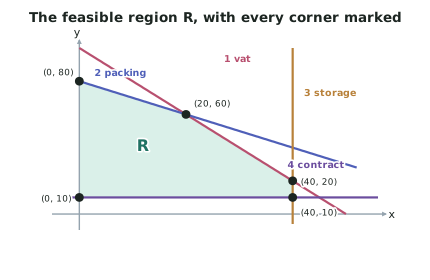
Draw the feasible region for the dairy model from the previous page, and find every corner exactly.
Step 1 — Find the intercepts of each boundary
Line (1):
- : →
- : →
Line (2):
- : →
- : →
Line (3): — vertical. Line (4): — horizontal.
Step 2 — Test the origin in each constraint
| Constraint | Test at | Allowed side |
|---|---|---|
| (1) | TRUE | towards origin |
| (2) | TRUE | towards origin |
| (3) | TRUE | towards origin |
| (4) | FALSE | away from origin |
Step 3 — Identify which lines form each corner, from the diagram
Reading the shape of the region, its boundary runs: up the line , along , along , down , and back along .
Step 4 — Corner A: meets
Check all constraints: (1) ✓ (2) ✓ (3) ✓ (4) ✓ Valid.
Step 5 — Corner B: meets
Check: (1) ✓ (3) ✓ (4) ✓ Valid.
Step 6 — Corner C: meets
Subtract the first from the second:
Substitute into :
Check: (3) ✓ (4) ✓ Valid.
Step 7 — Corner D: meets
Check: (2) ✓ (4) ✓ Valid.
Step 8 — Corner E: meets
Check: (1) ✓ (2) ✓ Valid.
Step 9 — Test a crossing point that is NOT a corner
Where does meet ? At .
Check constraint (1): ✗ Fails the vat limit.
Step 10 — State the region
It is bounded, so both a maximum and a minimum of the profit function exist and will be found at corners.
Step 11 — Note which constraints bind where
| Corner | Binding constraints | Meaning |
|---|---|---|
| , | no Halloumi, contract minimum only | |
| , packing | no Halloumi, all packing used | |
| packing and vat | both main resources fully used | |
| storage and vat | storage full, vat full | |
| storage, contract | storage full, contract at minimum |