Scheduling, resources and shortening the project
From analysis to a schedule
- The network says what is possible; the schedule says what will happen.
- A schedule assigns each activity a start date, choosing within its float where there is any.
- Two natural extremes:
- Earliest-start schedule — everything begins as soon as it can. Safest, since all float is kept in reserve.
- Latest-start schedule — everything begins as late as it can. Cheapest for cash flow, since money is spent later, but every activity becomes critical and there is no protection against delay.
- Most real schedules sit between the two, using float deliberately to smooth resources.
The Gantt chart
- A Gantt chart plots time along the horizontal axis and one row per activity.
- Each activity is a bar from its start to its finish, with its float shown as a lighter extension.
- Critical activities have no extension, so the critical path is visible as an unbroken run of solid bars from left to right.
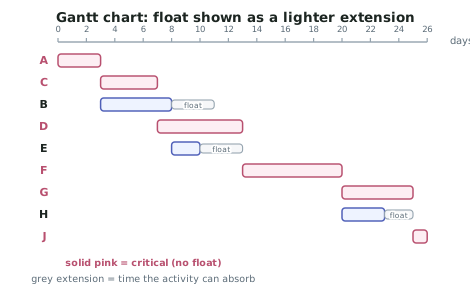
- What the chart shows that the network does not:
- What is running at the same time — read a vertical line down the chart
- When the workload peaks
- Where float sits, and therefore where activities could be moved
Resource scheduling
- The network assumes unlimited resources. In reality, two activities needing the same crew cannot both run on Tuesday.
- The method:
- Draw the Gantt chart on an earliest-start basis.
- Add up the resource needed on each day, and plot that as a resource histogram.
- Where a peak exceeds what is available, move non-critical activities within their float to flatten it.
- If flattening is impossible without moving a critical activity, the project must get longer — and that is a genuine finding to report.
- Only float can absorb resource clashes. This is what float is for, and it is the main reason for calculating free float separately.
Shortening the project
- Only the critical path controls the duration, so shortening anything else achieves nothing.
- The procedure:
- Shorten a critical activity by one time unit (more staff, overtime, plant hire).
- Recalculate both passes. The project falls by one unit — unless another path becomes critical.
- Repeat, watching for the moment a second path becomes critical.
- Once two paths are critical, both must be shortened together to gain anything further. That is where the cost of acceleration rises sharply, and saying so is a Merit/Excellence-level observation.
- There is a floor. Eventually every path is critical, or an activity cannot be shortened further, and no amount of money buys more time.
When a deadline is imposed
- If the project duration exceeds a required deadline, the shortfall is the finding, and the report should say:
- by how much the project is late,
- which critical activities could be shortened, and
- what happens to the critical path if they are.
- Do not report a negative float. If a deadline earlier than the computed duration is imposed, the correct statement is "the project is 3 days over the deadline", not "float ".
What the model leaves out
- Deterministic durations. Every duration is treated as exactly known. Real tasks vary, and a near-critical path with small float can become critical through ordinary variability.
- Finish-to-start only. The model assumes an activity cannot begin until its predecessor is entirely complete. Real projects often overlap tasks.
- Unlimited resources, unless resource scheduling is done separately.
- No cost. The network optimises time alone; the cheapest schedule and the fastest schedule are rarely the same.
- Naming one of these limits in the report is a genuine and quick way to show critical evaluation.
Worked ExampleMeeting a deadline on the deck project
The deck project takes 26 days with critical path . The client needs it finished in 22 days. The builder can shorten activities by hiring extra labour:
| Activity | Duration | Can be shortened by | Cost per day saved |
|---|---|---|---|
| C (clear site) | 4 | 2 days | $400 |
| D (foundations) | 6 | 3 days | $900 |
| F (frame) | 7 | 3 days | $700 |
| G (decking) | 5 | 2 days | $500 |
Determine the cheapest way to meet the deadline, and state what the critical path becomes.
Step 1 — Establish what must be saved
Step 2 — Identify the competing paths, before shortening anything
The critical path : days.
The parallel route through B and E replaces C and D with B and E:
The route through H instead of G:
Step 3 — Rank the shortenable activities by cost
| Activity | Cost per day | Max days | On which paths? |
|---|---|---|---|
| C | $400 | 2 | the routes only |
| G | $500 | 2 | the routes only |
| F | $700 | 3 | every path |
| D | $900 | 3 | the routes only |
Step 4 — Take the cheapest saving first: C, 1 day at $400
New path lengths: ; ; .
Project: 25 days. Still 3 to save.
Step 5 — Take C's second day, also $400
New lengths: ; ; .
Project: 24 days. Running total $800. C cannot be shortened further.
Step 6 — Next cheapest is G at $500
Shorten G by 1 day. appears on both the 24-day and 23-day routes:
- (unchanged — H route)
Project: 23 days. Running total $1,300.
Step 7 — One more day needed, and now TWO paths are at 23 and 22
Shorten G again? falls to 22, but is already at 22 — so the project stops at 22.
Cost of G's second day: $500. Running total $1,800.
Step 8 — Check the alternative: use F instead of G's second day
F is on every path. Shortening F by 1 day at $700 gives:
Project: 22 days, at a cost of .
Step 9 — State the cheapest solution
Step 10 — Verify by recomputing every path
| Path | Original | Shortened | Length |
|---|---|---|---|
| 22 | |||
| 22 | |||
| 21 | |||
| unchanged | 21 |
Step 11 — State the new critical path(s)
H, which previously had 2 days of float, is now critical. The handrail crew no longer has any flexibility.
Step 12 — Advise the client
Two consequences the client should know:
- The project is now far more fragile. With two critical paths and only the B–E chain retaining float, a delay to almost any activity now delays the whole project. At 26 days, three activities had slack; at 22 days, only two do.
- Further acceleration is expensive. To reach 21 days, both critical paths must shorten, which means shortening F (on every path) at $700, or shortening G and H together — and H has no stated shortening option at all. The $450-per-day average cost of the first four days rises to at least $700 for the fifth.
A limitation worth stating: these durations are treated as exact. At 22 days the schedule has almost no slack, so ordinary variability — a wet week, a late inspection — is now much more likely to push the finish out. The client is buying speed at the cost of resilience.