The sine rule
Labelling a triangle
- The standard convention makes every formula readable:
- Capital letters (, , ) label the angles — or the vertices.
- Lower-case letters (, , ) label the sides.
- Each side is opposite the angle with the same letter. Side is opposite angle .
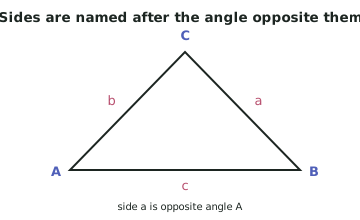
- Label your own diagram this way before doing anything else. It converts the formulae from something to memorise into something to read off.
When the sine rule applies
- Use the sine rule when you have a matching pair — a side and the angle opposite it.
- The two situations:
- Two angles and any side (AAS or ASA)
- Two sides and an angle opposite one of them (SSA) — the ambiguous case
The formula
- For finding a side:
- For finding an angle, turn it upside down so the unknown is on top:
- Both forms are the same equation. Choosing the one with the unknown in the numerator saves a rearranging step and a chance to slip.
- You only ever use two of the three fractions at a time.
Finding a side
-
Identify the matching pair you know completely.
-
Write the two fractions, with the unknown side on top.
-
Multiply across and solve.
-
Worked through — in triangle , , and cm. Find .
- Matching pair: with
- cm
Finding an angle
-
Use the inverted form, then apply .
-
Worked through — , , . Find .
The ambiguous case
-
This is the trap in the sine rule, and it only arises when you are given two sides and a non-included angle and are solving for an angle.
-
The issue: . Both and have the same sine, so the calculator's answer is only one of two possibilities.
-
How to check:
- Find the acute angle from .
- Calculate the obtuse alternative, .
- Test whether the obtuse option still leaves a positive third angle: does ?
- If yes, both triangles are possible and you must give both, or use the context to choose.
- If no, only the acute answer works.
-
A reliable shortcut: the ambiguous case can only occur when the side opposite the known angle is shorter than the other known side. If the known angle is opposite the longer side, the answer is unique.
-
Note that the ambiguity never arises when you are finding a side, or when the given angle is already obtuse.
Finding the third angle
- The angles of any triangle sum to , so once two are known the third is free:
- Do this before using the sine rule if it gives you the matching pair you need.
When not to use it
- The sine rule needs a complete matching pair. If you know two sides and the angle between them, or all three sides, there is no such pair — use the cosine rule instead.
Worked ExampleThe ambiguous case
In triangle , cm, cm and . Find all possible values of angle , and the corresponding values of side .
Step 1 — Decide which rule applies
We know a side and its opposite angle ( with ) — a complete matching pair — plus one more side. That is the sine rule, in the SSA configuration.
Step 2 — Check whether ambiguity is possible
The known angle is opposite side , and the other known side is .
Since , the side opposite the known angle is the shorter one — so the ambiguous case may arise and both possibilities must be checked.
Step 3 — Set up the sine rule for angle
Put the unknown on top:
Step 4 — Solve for
Step 5 — Find both possible angles
The acute solution:
The obtuse alternative, since :
Step 6 — Test whether each gives a valid triangle
Case 1:
Positive ✓ — a valid triangle.
Case 2:
Also positive ✓ — also a valid triangle.
Step 7 — Find for each case
Case 1, with :
Case 2, with :
Step 8 — State both solutions
Step 9 — Sense-check
In each triangle, the largest side is opposite the largest angle:
- Triangle 1: largest angle opposite , the longest side ✓
- Triangle 2: largest angle opposite , the longest side ✓
Both are internally consistent. In a real context you would use extra information — a sketch, a bearing, or a stated obtuse/acute condition — to decide which triangle is meant.