The cosine rule and the area of a triangle
When the cosine rule applies
-
Use the cosine rule when there is no matching pair — when the sine rule cannot get started.
-
The two situations:
- Two sides and the INCLUDED angle (SAS) — the angle between the two known sides
- All three sides (SSS), when you want an angle
-
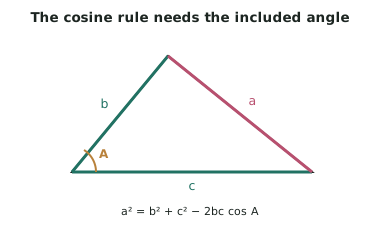
The word "included" is the key. If the known angle sits between the two known sides, it is the cosine rule; if it is opposite one of them, it is the sine rule.
Finding a side
-
Each part:
- — the side you want, opposite the known angle
- , — the two sides you know
- — the included angle, between and
-
The structure to notice: it is Pythagoras with a correction term. If then and the formula collapses to — Pythagoras is the special case.
-
Worked through — cm, cm, :
- cm
-
Do not take the square root until the very end, and remember that only the positive root is a length.
Finding an angle
- Rearranged to make the angle the subject:
-
The side opposite the angle you want goes in the numerator with the minus sign. Getting that wrong finds a different angle.
-
Worked through — , , . Find :
-
The cosine rule has no ambiguous case. Cosine is negative for obtuse angles and positive for acute ones, so returns the single correct answer every time. That is a genuine advantage over the sine rule.
-
A negative cosine means an obtuse angle — that is information, not an error.
The area of a triangle
-
Each part:
- , — two sides
- — the angle between them
-
Again the angle must be the included one. The formula is .
-
This generalises . The height of the triangle is , so the two formulae are the same statement.
-
Worked through — cm, cm, included angle :
- Area cm2
Choosing between the rules
-
Ask what you have been given, in this order:
- Is there a right angle? → SOH CAH TOA and Pythagoras, which are simpler
- Is there a complete matching pair (a side and its opposite angle)? → sine rule
- Otherwise → cosine rule
-
In a multi-step problem you will often use both. A common pattern is: cosine rule to find one missing side or angle, then sine rule for the rest.
-
Once you have used the cosine rule to find a side, the sine rule becomes available, because you now have a matching pair.
Multi-step problems
- Merit and Excellence questions rarely need one formula.
- Work out what you can, then look again. Each new value may unlock a rule that was not available before.
- Label everything on the diagram as you find it, so you can see at a glance what is still missing.
Worked ExampleA multi-step problem combining both rules
A triangular paddock has sides m and m, with the angle at measuring . Find the length of , the size of angle , and the area of the paddock.
Step 1 — Decide which rule to start with
We know two sides ( and ) and the angle between them ().
There is no matching pair — we do not know any side together with its opposite angle — so the sine rule cannot start. This is the included angle situation, so the cosine rule applies.
Step 2 — Label using the standard convention
- Side is opposite angle , so — the side we want
- Side is opposite , so m
- Side is opposite , so m
Step 3 — Apply the cosine rule
Work out each piece:
Step 4 — Take the square root, once, at the end
Sense-check: is a fairly wide angle, so the opposite side should be the longest — and ✓
Step 5 — Now find angle
We now have a complete matching pair: with . That makes the sine rule available, which it was not at the start.
Step 6 — Check the ambiguous case
The obtuse alternative would be . Testing it:
Negative, so impossible. The obtuse option is rejected and is the only solution.
Step 7 — Find the area
We know two sides and the included angle, which is exactly what the area formula needs:
Step 8 — Final check
As a cross-check on angle , find and confirm the angles sum correctly:
The largest angle is opposite the longest side ✓, and the smallest angle is opposite the shortest side ✓ Everything is consistent.