Assessing export readiness
What export readiness means
- Export readiness is whether this business is in a position to export now: whether it has the capacity, the money, the people, the systems and the product to sell offshore without damaging what it already has.
- It is a genuinely separate question from whether anyone wants the product. Many businesses with strong export potential are not export-ready, and the honest finding of an investigation is often "yes, but not yet, and here is what has to happen first".
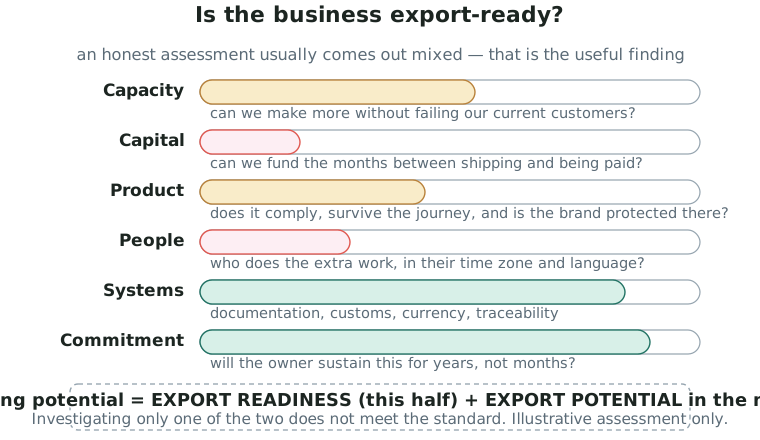
The six dimensions to assess
- Capacity.
- Can the business make more than it currently sells, and by how much?
- Could it meet a large first order without failing its existing customers? Losing the domestic base to serve a new export customer is a real and common failure.
- What would extra capacity cost, and how long would it take to install?
- Is supply of the key input reliable at a higher volume?
- Capital and cash flow.
- Exporting consumes cash long before it produces any: research, registration, certification, translation, travel, samples, stock in the pipeline, and then payment terms measured in weeks after delivery.
- Can the business fund that gap from reserves, from borrowing, or with support?
- What happens to the business if the first year produces no profit at all?
- The product.
- Does it comply with the destination market's rules — ingredients, labelling, language, safety standards, certification?
- Does it need to change — size, format, flavour, packaging, name?
- Does it survive the journey? Shelf life, temperature, handling, humidity.
- Is its intellectual property protected in that market, or could someone register the name there first?
- People and skills.
- Does anyone in the business have export experience?
- Who will do the extra work? In a small business the answer is usually the owner, who is already fully occupied.
- Is there language or cultural capability, or a plan to buy it in?
- Can someone respond in the market's business hours?
- Systems.
- Can the business handle export documentation, customs, freight and foreign currency?
- Are its production records good enough to satisfy an overseas buyer's audit?
- Can it trace a batch if there is a recall?
- Commitment.
- Is the owner or board prepared to sustain the effort for years rather than months?
- Is exporting part of the business's strategy, or a response to a quiet domestic quarter?
- This is the dimension that most often decides the outcome, and it is the one students least often ask about.
Assessing it honestly
- Score each dimension and say what the evidence is:
| Dimension | Assessment | Evidence |
|---|---|---|
| Capacity | Partly ready — could increase output 30% on current plant | Owner interview, 14 May |
| Capital | Not ready — no reserves for a 6-month cash gap | Owner interview |
| Product | Partly ready — labelling and ingredient compliance not yet checked | Desk research on destination rules |
| People | Not ready — owner is the only person who could do it and is fully occupied | Owner interview |
| Systems | Ready — batch traceability already in place for a domestic retailer | Site visit, 21 May |
| Commitment | Ready — exporting is in the business's three-year plan | Owner interview |
- (Invented business, illustrative assessment.)
- A mixed result is the normal and most useful finding. It gives the investigation something to conclude: what must change before this business could export, in what order, and what it would cost.