Researching the market
The questions to answer
- Export potential is whether this product can sell in this market. Six questions, in order:
- Is there demand? Do people there buy this kind of product, and is that market growing or shrinking?
- Who already supplies it? Local producers, other importers, and what they charge.
- What is different about our product? Something a buyer in that market would actually value — and note that "New Zealand made" is only a differentiator where that means something to them.
- What price could it achieve? The shelf price, worked back through retailer and distributor margins, tariffs and freight, to what the business would actually receive.
- How would it reach customers? Which channels exist, and who controls them.
- What has to change about the product to be sellable there?
Working the price backwards
- This is the single most useful calculation in the investigation, and the one that most often changes the conclusion. Start from a realistic shelf price and work back to what the exporter receives.
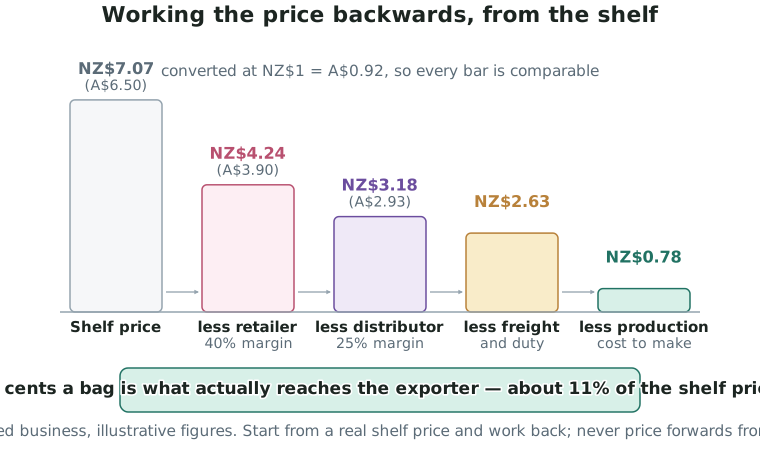
- The shape of that chart is the point: most of the shelf price never reaches the exporter. Pricing forwards from cost hides that, which is why investigations that do it reach the wrong conclusion.
Worked ExampleWorking an export price backwards from the shelf
Kāpiti Kūmara Crisps (invented business, illustrative figures) is investigating export to Australia. Comparable premium vegetable crisps sit on Australian specialty grocery shelves at A$6.50 for a 100 g bag. The business's variable cost of production is NZ$1.85 a bag.
Assume: retailer margin 40% of the shelf price, distributor margin 25% of what they on-sell for, freight and duty NZ$0.55 a bag, and an exchange rate of NZ$1 = A$0.92.
Work out what the business would receive, and whether the export is viable.
Step 1 — Take the retailer's margin off the shelf price
The retailer keeps 40%, so the distributor sells to them for 60% of A$6.50.
6.50 × 0.60 = A$3.90
Step 2 — Take the distributor's margin off that
The distributor keeps 25% of what they sell for, so the exporter's price to the distributor is 75% of A$3.90.
3.90 × 0.75 = A$2.925, which rounds to A$2.93
Step 3 — Convert to New Zealand dollars
At NZ$1 = A$0.92, divide the Australian figure by 0.92.
2.925 ÷ 0.92 = NZ$3.18
Step 4 — Subtract the costs of getting it there
3.18 − 0.55 (freight and duty) = NZ$2.63 received per bag, before production cost
Step 5 — Compare with the cost of making it
2.63 − 1.85 = NZ$0.78 contribution per bag
What this means. Every bag exported contributes 78 cents towards the business's fixed costs and profit — a contribution margin of about 30% on the NZ$2.63 received. That is workable, but thin: a 10% fall in the exchange rate, or a distributor demanding a 30% margin instead of 25%, would remove most of it.
The conclusion the investigation should draw from this. The export is viable at this shelf price, but the business has very little room to absorb an adverse movement, so the investigation should recommend either a higher shelf price positioning or a cost reduction before committing — and should treat the exchange rate as a risk to be managed rather than assumed.
Where to get the information
- Published sources first, because they are free and immediate:
- official New Zealand trade and export statistics, showing what already goes to that market
- the destination country's import statistics and food or product standards authority
- industry association reports for the sector
- retailer websites and online marketplaces in the destination market, which show real shelf prices, pack sizes and competitors
- Then targeted primary contact:
- a New Zealand business already exporting to that market — often the most useful single conversation available
- an offshore distributor or importer in the sector
- a trade commission or in-market agency
- the business's own contacts, if it has any
- Record everything — this standard requires evidence of an investigation, and correspondence, meeting notes and market analysis are named as acceptable evidence.