The quadruple bottom line
Four outcomes, not one
- The standard defines sustainable as an ongoing focus on economic, social, cultural (including ethical) and environmental outcomes, and defines evaluate as measuring the activity's performance against them.
- The teaching guide names the analytical tool: the quadruple bottom line. A conventional business reports one bottom line — profit. A quadruple bottom line reports four, and treats them as equally real.
- This is where Māori business concepts connect directly. Many Māori businesses already operate to a multiple bottom line — pūtake, the reason for being, includes social, cultural and environmental purposes alongside profit — and kaitiakitanga, manaakitanga and purotu (accountability across generations) describe exactly what the quadruple bottom line is trying to measure.
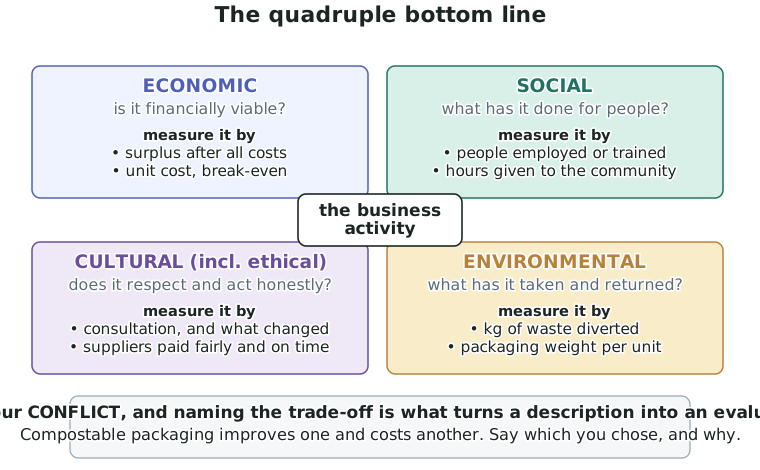
The four outcomes, and how to measure each
- Economic.
- The question: is the activity financially viable, and does it create value?
- Measures: revenue, costs, gross margin, profit or surplus, cash position, break-even point, unit cost, money returned to participants or a cause.
- This is the easiest to measure and the one students over-weight. It is one quarter of the evaluation, not all of it.
- Social.
- The question: what has it done for people and for the community?
- Measures: number of people employed or given experience; skills gained, recorded before and after; hours contributed to or by the community; customers served who could not previously access the product; wellbeing, measured by a survey; partnerships formed with community organisations.
- Cultural (including ethical).
- The question: does it respect the values and identity of the people it affects, and is it run honestly?
- Measures: consultation undertaken with the communities affected and what changed as a result; use of te reo Māori and tikanga, and whether that use was guided by the right people; where materials came from and whether the people who made them were treated fairly; honesty in claims and pricing; how the activity handled a mistake.
- Environmental.
- The question: what has it taken from and returned to the natural world?
- Measures: waste produced and diverted, in kilograms; packaging used, per unit; energy or fuel used; kilometres travelled; water used; materials sourced from recycled or diverted streams; anything restored or replanted.
Making the outcomes measurable
- The difference between a sound evaluation and a thorough one is almost entirely in whether the measures were set up in advance.
- For each of the four outcomes, decide before you start:
- What exactly will be measured — a number, not a feeling
- Where the figure comes from — sales records, a scale, a receipt, a survey, a count
- What the starting position is — the baseline, without which no change can be shown
- What result would count as success — set a target, so the evaluation has something to judge against
- A simple table is enough:
| Outcome | Measure | Baseline | Target | Actual |
|---|---|---|---|---|
| Economic | Surplus after all costs | $0 | $400 | |
| Social | Students trained in food handling | 0 | 8 | |
| Cultural | Suppliers paid within 7 days | n/a | 100% | |
| Environmental | Kilograms of produce diverted from waste | 0 | 120 kg |
- (Invented activity, illustrative figures.)
The tensions between them
- The four outcomes conflict, and saying so is what turns a description into an evaluation.
- Compostable packaging is better environmentally and costs more, which reduces the economic outcome.
- Paying suppliers a fair price is a cultural and ethical gain and raises the unit cost.
- Employing people who need the experience is a social gain and slows production.
- Consulting properly takes time the activity's schedule may not have.
- A thorough evaluation names the trade-off it accepted, says why, and judges whether the exchange was worth making. A weak one reports four outcomes as if they were independent.