Gradualism and punctuated equilibrium
Two models of the rate of evolutionary change
- Both models accept natural selection and common descent. They disagree only about the rate at which change occurs, and about how to read the fossil record.
-
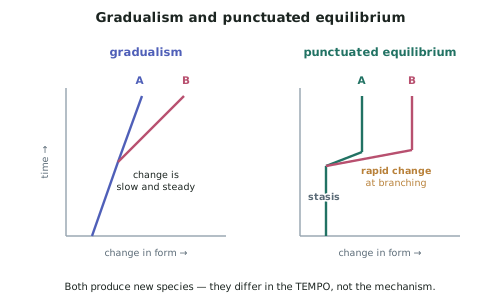
The two graphs are the whole disagreement. Gradualism draws a lineage that leans steadily; punctuated equilibrium draws long vertical stretches of stasis broken by short horizontal jumps at branching points.
-
Gradualism proposes that evolutionary change is slow, steady and continuous.
- Species change gradually over long periods, accumulating small differences.
- New species arise by the gradual transformation of an entire lineage.
- It predicts the fossil record should contain many intermediate forms, showing a smooth series of small changes.
-
Punctuated equilibrium proposes that evolutionary change is concentrated into short bursts, separated by long periods of little change.
- Stasis — long periods, often millions of years, in which a species changes very little.
- Punctuation — short periods of rapid change, usually associated with speciation events.
- It predicts the fossil record should show species appearing abruptly, persisting largely unchanged, then disappearing — with few intermediates.
Comparing the two models
| Gradualism | Punctuated equilibrium | |
|---|---|---|
| Rate of change | Slow and constant | Variable — bursts and stasis |
| When change occurs | Continuously | Mostly at speciation |
| Where change occurs | Throughout the whole population | Often in small, isolated populations |
| Fossil prediction | Many intermediates | Abrupt appearance, long stasis |
| Explains gaps as | Incomplete fossil record | Real absence of intermediates |
- The critical difference is how each explains the scarcity of intermediate fossils:
- Gradualism says intermediates existed but were not preserved, because fossilisation is rare and the record is incomplete.
- Punctuated equilibrium says intermediates are scarce because the transitional period was genuinely brief, and occurred in a small, localised population unlikely to leave fossils.
Why punctuated equilibrium is plausible
-
The model fits well with what is already known about speciation:
- Allopatric speciation often begins with a small, isolated founding population. Small populations change fast, because drift is strong and selection can shift a small population quickly.
- A small, geographically restricted population is very unlikely to be fossilised — few individuals, small area, short time.
- The new species may then spread, appearing suddenly in the fossil record of a wide area, already distinct.
- Once well established and large, the species experiences stabilising selection in a stable environment, so it changes little — producing stasis.
-
So the pattern punctuated equilibrium describes is what allopatric speciation followed by stabilising selection would be expected to leave behind.
The models are not mutually exclusive
- This is the key point for Excellence. The debate is not "which is correct" but which applies where.
- The evidence supports both, in different lineages and circumstances:
- Some fossil sequences show smooth, gradual change over long periods.
- Others show clear stasis punctuated by rapid change.
- Expected influences on which pattern occurs:
- Stable environments favour stasis, because stabilising selection removes extremes.
- Rapidly changing environments favour bursts of directional change.
- Large populations change slowly — drift is weak and there is more genetic inertia. Small, isolated populations change fast.
- Polyploidy is the extreme case: speciation in a single generation, which no gradual model can accommodate.
Why this belongs to the Nature of Science
- This standard is derived partly from the Nature of Science strand — that scientists must connect new ideas to existing knowledge and submit findings for peer review and debate.
- Punctuated equilibrium is a good illustration:
- It was proposed as a reinterpretation of existing evidence — the same fossil record, read differently — rather than from new data.
- It was debated vigorously and initially resisted, partly because it was misread as an attack on natural selection, which it is not.
- The outcome was not that one model won, but that both were refined, and the field now accepts that evolutionary rates vary.
- That is how science is supposed to work: a claim is tested against existing knowledge, argued over publicly, and the position revised.
Selective advantage
- These are models of rate, not responses, so neither has a selective advantage of its own. But selection explains both patterns:
- Stasis results from stabilising selection in a stable environment: intermediate forms are favoured and extremes are removed, so the mean does not shift. Stasis is therefore an active outcome of selection, not an absence of it — a point worth making, since students often describe stasis as "nothing happening".
- Punctuation results from directional selection when the environment changes, or in a small founder population where selection and drift can shift allele frequencies quickly.
Worked Example
Worked Example
A continuous marine sediment sequence spanning 8 million years is sampled for fossils of one shellfish lineage. Shell shape is measured.
- From 8 to 3.2 million years ago, shell shape varies only slightly around a constant mean.
- Between 3.2 and 3.1 million years ago, mean shell shape changes markedly, and two distinct forms appear.
- From 3.1 million years ago to the present, both forms persist with little further change.
- Sediment cores from a small nearby basin show that one form was already present there 3.4 million years ago.
- The sequence has no gaps — deposition was continuous throughout.
Which model of evolutionary change do these data support? Justify your answer.
Answer:
The data support punctuated equilibrium.
The pattern. Shell shape shows long stasis from 8 to 3.2 million years ago, a brief episode of rapid change lasting about 100,000 years — roughly 1% of the sequence — and then stasis again for 3.1 million years. That is exactly the pattern punctuated equilibrium predicts: long periods of little change, interrupted by short bursts associated with speciation.
Why the completeness of the record is decisive. Normally a scarcity of intermediates could be dismissed as an artefact — gradualism explains missing intermediates by saying the fossil record is incomplete. That defence is unavailable here, because the sequence is continuous with no gaps.
If change had been gradual, continuous deposition would have captured a smooth series of intermediate forms spread across the whole 8 million years. Instead the record shows almost no change for 4.8 million years, then abrupt change confined to a very short interval. The absence of intermediates is therefore real, not a preservation artefact.
This is what makes the data evidence rather than merely consistent with the model — a gappy sequence would not have discriminated between the two hypotheses at all.
What the nearby basin shows. One form was present in a small nearby basin 3.4 million years ago — 300,000 years before it appears in the main sequence. This supports the mechanism punctuated equilibrium proposes:
- The new form arose in a small, geographically restricted population, isolated in the small basin.
- Small populations change rapidly, because genetic drift is strong and selection can shift allele frequencies quickly in few individuals.
- Such a population is unlikely to be sampled in a fossil record from elsewhere — few individuals, small area, short time.
- Once established, the new form spread into the main basin, where it appears abruptly, already distinct, with no local intermediates.
So the apparent suddenness in the main sequence is partly a consequence of the change happening somewhere else — this is allopatric speciation seen through the fossil record.
Why stasis is not simply an absence of evolution. The 4.8 million years of stasis is itself explained by selection. In a stable environment, stabilising selection favours intermediate forms and removes extremes, so variation is maintained around a constant mean and the mean does not shift. Stasis is an active outcome of selection, not evolution failing to occur.
A necessary qualification. These data support punctuated equilibrium for this lineage, over this period. They do not show that gradualism is wrong in general — other lineages show smooth gradual change over long periods, and both patterns are well documented.
The two models are best treated as describing different circumstances rather than competing universal claims. Which pattern occurs is expected to depend on environmental stability (stable favours stasis), population size (small populations change faster) and the mode of speciation (allopatric speciation from a small founder population produces exactly the punctuated pattern seen here). Note also that "rapid" here means about 100,000 years — geologically brief, but many thousands of generations, so this is entirely compatible with ordinary natural selection.