Allopatric speciation: divergence in separate places
What allopatric speciation is
- Allopatric speciation is speciation that begins with a geographical barrier separating populations.
- Allo- means "other", -patric means "homeland" — populations in different places.
- It is the most common mode of speciation, because a geographical barrier is the simplest and most complete way to stop gene flow.
The sequence
-
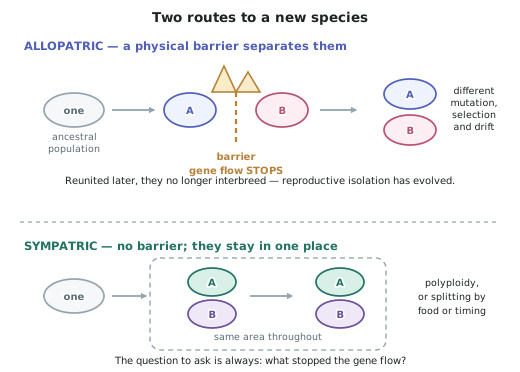
The difference between the two routes is only ever where the gene flow stops — at a physical barrier in allopatric speciation, and within a single area in sympatric speciation. Everything after that point is the same process.
-
Allopatric speciation always follows the same four stages. Setting them out in order is the safest structure for any answer:
-
1. A barrier arises. A single population is divided by something individuals cannot cross.
- Geological — mountain building, rifting, a river changing course, an island separating from a mainland.
- Climatic — sea level rise flooding a land bridge, or glaciation splitting a forest into refuges.
- Dispersal — a small group crosses a barrier and founds a new population, as when birds or seeds reach an offshore island.
-
2. Gene flow stops. Alleles no longer move between the populations, so differences can begin to accumulate instead of being mixed away.
-
3. The populations diverge.
- Natural selection favours different alleles in each, if conditions differ.
- Genetic drift changes frequencies by chance independently in each, especially where a population is small — as it always is after a founder event.
- Different mutations arise in each population, and each is confined to the population it arose in.
-
4. Reproductive isolation evolves. Differences accumulate until the populations can no longer interbreed successfully even if they meet again.
-
Only at stage 4 are they separate species. Stages 1–3 are reversible: if the barrier is removed, gene flow resumes and the populations merge again.
What happens when the barrier is removed
- This is a favourite exam scenario, and there are three possible outcomes:
- Merging — divergence was insufficient, the populations interbreed freely and become one population again.
- Reinforcement — hybrids form but are inviable or sterile. Because such matings waste reproductive investment, selection strengthens prezygotic isolation, and speciation is completed.
- A stable hybrid zone — the populations interbreed in a narrow area of contact but remain distinct on either side.
New Zealand as a natural experiment
-
New Zealand is unusually informative about allopatric speciation, because it supplies barriers of several kinds and known ages.
-
Ocean separating offshore islands. The Chatham Islands, about 800 km east, hold many endemic species derived from mainland colonists — including the Chatham Island black robin and Chatham Island forget-me-not. Each began as a founder event by a small number of dispersers.
-
The Southern Alps. Uplift over the last few million years divided populations east and west, and also created altitudinal habitat that new alpine species colonised.
-
Glacial refuges. During glaciations, forest contracted into separate refuges. Populations isolated in different refuges diverged, and the pattern is still visible in the genetics of many species today.
-
Kiwi provide a clear case: several species are distributed in largely non-overlapping areas, consistent with populations that were separated and diverged in isolation.
Why founder events matter so much here
- Most New Zealand colonisations began with very few individuals crossing ocean, and this makes divergence unusually fast:
- The founders carry an unrepresentative sample of alleles — the founder effect — so the new population starts out different immediately.
- The population is small, so drift is strong and continues to change frequencies rapidly.
- The new environment often differs — different predators, competitors and food — so selection also pushes the population away from the source.
- All three act together and in the same direction, which is why island populations diverge much faster than mainland ones of the same age.
Selective advantage
- Allopatric speciation is a process, not a behaviour, so it has no selective advantage of its own. But selection is one of its drivers:
- In each isolated population, individuals whose characteristics suit local conditions leave more offspring, so each population becomes locally adapted.
- Local adaptation is advantageous to the individuals concerned. Reproductive isolation is a by-product of the differences accumulating, not something selected for.
- The exception is reinforcement on secondary contact, where avoiding hopeless hybrid matings genuinely is advantageous to the individual.
Worked Example
Worked Example
A flightless beetle lives in forest on both sides of a large river. The river changed course about 12,000 years ago, creating the present channel.
- Beetles from the north and south banks look nearly identical.
- DNA analysis shows the two populations differ at 4.1% of the sites examined; two populations on the same bank differ at only 0.3%.
- In the laboratory, north × south crosses produce offspring, but only 34% of the offspring are fertile.
- Beetles placed together in an arena court and mate readily regardless of which bank they came from.
Explain what has happened, and discuss whether these are separate species.
Answer:
What has happened: allopatric divergence.
The beetles are flightless, so a large river is an absolute barrier — they cannot cross it. Note that the same river would be no barrier at all to a flying insect; whether something is a barrier depends on the organism's dispersal ability.
When the river changed course about 12,000 years ago, it divided a single population into two. Gene flow stopped, so alleles could no longer move between the banks.
Since then the two populations have diverged:
- Different mutations arose in each population, and each was confined to the population where it occurred.
- Genetic drift changed allele frequencies by chance, independently on each bank.
- Natural selection may also have acted differently if conditions differ between the banks.
The DNA data confirm this quantitatively. Populations on the same bank, which still exchange genes, differ at only 0.3% of sites. Populations on opposite banks differ at 4.1% — over ten times as much. That contrast is exactly what isolation predicts, and the same-bank comparison acts as a control showing the difference is due to the river rather than simply to distance.
Are they separate species?
The evidence is mixed, and saying so is the correct answer rather than forcing a verdict.
Evidence they are becoming separate:
- Postzygotic isolation has begun. Only 34% of hybrid offspring are fertile, against a normal expectation near 100%. The genomes have diverged enough that meiosis in hybrids often fails, so most hybrids leave no descendants.
- Substantial genetic divergence has accumulated.
Evidence they are not yet separate:
- No prezygotic isolation exists. The beetles court and mate readily regardless of bank, so mate recognition has not diverged at all.
- Hybrids are produced, and 34% are fertile. Isolation is incomplete — a third of hybrids can still pass alleles between the populations.
Conclusion. These are best described as populations at an intermediate stage of speciation — diverged substantially, with partial postzygotic isolation, but not yet fully isolated. Under a strict biological species concept they are not yet separate species, because they can still interbreed and produce some fertile offspring.
This is not an unsatisfactory answer but the expected one: speciation is a continuous process, so populations caught partway through it will not fit a discrete category cleanly.
What would happen if the river changed course again.
Two outcomes are possible, and which occurs depends on the strength of selection against hybrids:
- If the 34% fertility cost is substantial, individuals that mate with their own population leave far more surviving fertile descendants than those that hybridise. Selection would then favour any heritable difference in mate recognition — reinforcement — and prezygotic isolation would evolve, completing speciation.
- If the cost is too small relative to the amount of interbreeding, gene flow would exceed the rate at which differences accumulate, the populations would merge, and 12,000 years of divergence would be erased.