Question types and response options
What a questionnaire is for
- A questionnaire collects data to answer an investigative question (e.g. "What do students think of the canteen?").
- Every question should help answer that purpose — if a question does not, cut it.
Start by clarifying the information needs
The standard's first assessed component is clarifying the specific information needs of the survey and the groups who will use the data. It happens before a single question is written.
- Name the purpose precisely. "Find out about the canteen" is not a purpose; "find out whether students would buy a hot meal at lunchtime, and at what price" is.
- Name who will use the data, and what decision they will make with it. The canteen manager deciding whether to add a hot-meal option needs different information from a student council writing a submission.
- List the specific things you need to find out, then check every question you write against that list. This is what stops a questionnaire drifting into interesting-but-useless territory.
- Different users need different detail. If the manager needs to know pricing, a yes/no question about whether students "like the idea" will not support the decision — the information need dictates the question, not the other way round.
Variables and measures
The next component is determining relevant variables and appropriate measures for each, while thinking about sources of variation.
- A variable is one thing you are collecting about each respondent — year level, how often they buy lunch, how much they would pay.
- A measure is how you will capture that variable — a number, a category, or a point on a scale.
- Choose the measure that matches how you will use the data:
- "Do you buy lunch? Yes / No" gives you a count, and nothing more
- "How many days a week do you buy lunch? 0–5" gives you a number you can average and compare
- The second is more useful, and costs the respondent no more effort — which is the kind of decision this standard rewards you for explaining
- Think about sources of variation — the reasons answers will differ between people. Year level, whether they bring lunch from home, and how much money they have all cause variation in canteen spending, so you may need to collect those variables too in order to make sense of the answers.
- Only collect a variable you will actually use. Each extra question costs response rate, and unused questions are marked as a flaw in the design.
Open and closed questions
- Open question — the respondent writes their own answer.
- Gives rich, detailed replies, but is hard to summarise and compare.
- Closed question — the respondent picks from given options.
- Quick to answer and easy to analyse (you can count and graph the options), but only as good as the options you provide.
Response formats for closed questions
- Dichotomous — exactly two options (Yes / No).
- Multiple choice — pick one from several.
- Checklist — "select all that apply".
- Rating (Likert) scale — a scale of agreement or frequency:

- Numerical — a number (age, how many days).
Good response categories: exclusive and exhaustive
- Options must be mutually exclusive — no answer fits two categories.
- Options must be exhaustive — there is a category for everyone (add "Other" or an open end if needed).
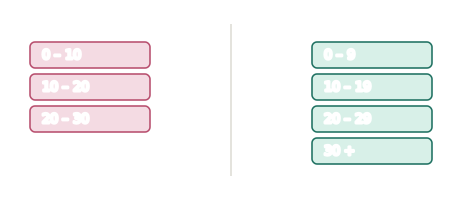
- The classic error is overlapping number ranges like — age 10 fits both. Use instead.
Worked ExampleDesigning response options
Write a closed question, with response options, to find out how often students exercise each week.
Step 1 — Choose the type
A numerical range (multiple choice) suits "how often per week".
Step 2 — Draft exclusive, exhaustive categories
Step 3 — Check the categories
- Mutually exclusive? No two boxes share a value (1–2, 3–4, …). ✓
- Exhaustive? Every possible answer from 0 to 7 days has a box. ✓