The area of a triangle
When "half base times height" isn't enough
- The familiar needs the perpendicular height, which you often don't have.
- If instead you know two sides and the angle between them, use the trig area formula:
- , — the two known sides.
- — the included angle, the one between those two sides.
- The effectively supplies the missing height, so no perpendicular is needed.
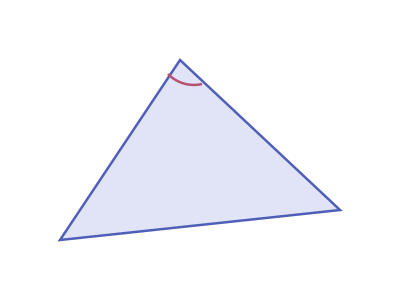
Using the formula
- Identify the two sides and the angle wedged between them — the angle must be included, not opposite.
- Substitute and evaluate; area comes out in squared units.
A triangular sail has two edges of m and m meeting at an angle of . Find its area.
Step 1 — Identify the parts
, , included angle .
Step 2 — Substitute
Step 3 — Evaluate
A triangle has two sides of cm and cm and an area of cm². Find the included angle (give the acute value).
Step 1 — Substitute into the area formula
Step 2 — Solve for
Step 3 — Inverse sine
Test yourself
Practice by grade
One question each at Achieved, Merit and Excellence. Have a go, then compare with the model answer.
Achieved
Find the area of a triangle with sides cm and cm and an included angle of .
Merit
A triangular garden bed has sides m and m with an area of m². Find the included angle.
Excellence
In triangle , cm, cm and cm. Find its area. (Hint: find an angle with the cosine rule first.)