Differentiating polynomials
What differentiation does
- The gradient measures steepness. On a straight line it is constant, but on a curve it changes from point to point.
- Differentiation finds the gradient function (also called the derivative) — a new expression that gives the gradient of the curve at any value of .
- Notation: the derivative of is written (read "dee y by dee x"); for a function it is written ("f dash of x"). They mean the same thing.
The power rule
- To differentiate a power of : bring the power down to multiply, then reduce the power by 1:
- A coefficient (number in front) is kept and multiplied through: .
- So .
Differentiating a whole polynomial
- Differentiate each term separately and keep the / signs between them.
- The derivative of a plain number (constant) is 0 — a constant is a flat, horizontal line with zero gradient.
- The derivative of (i.e. ) is just , because the power 1 drops to .
Seeing the gradient function on a graph
- The derivative is itself a function, so it has its own graph. Putting the two graphs side by side shows exactly what the "gradient function" is doing.
- Take the curve . Differentiating gives the gradient function .
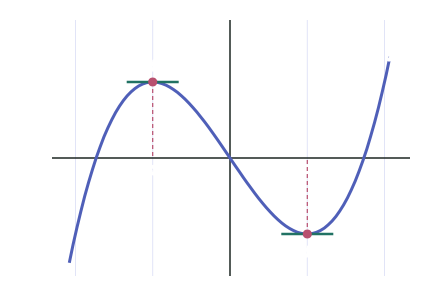
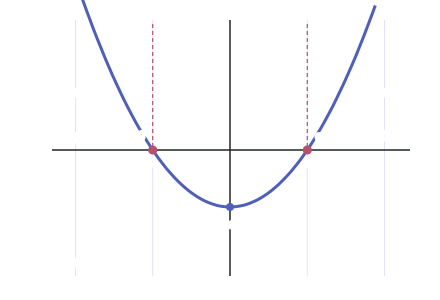
- Read the two graphs together, lining up the same -values (the dashed lines join the matching points):
- Where the curve is flat — its turning points at and — the gradient is zero, so the gradient graph crosses the -axis at exactly those -values.
- Where the curve slopes down (between and ), the gradient is negative, so the gradient graph sits below the -axis.
- Where the curve slopes up ( and ), the gradient is positive, so the gradient graph sits above the -axis.
- The steeper the curve, the further from zero the value on the gradient graph.
- So the gradient function is a map of the original curve's steepness: read off any , and it tells you the slope of the curve at that point.
Differentiate .
Step 1 — Apply the power rule to each term
- (the power 1 drops to )
- (a constant has zero gradient)
Step 2 — Write the derivative
Find the gradient of at the point where .
Step 1 — Differentiate to get the gradient function
Step 2 — Substitute the -value of the point
The gradient at that point is (negative, so the curve is sloping downwards there).
Differentiate .
Step 1 — Differentiate each term with the power rule
- (the power of 1 drops to )
- (a constant has zero gradient)
Step 2 — Write the derivative
Test yourself
Practice by grade
One question each at Achieved, Merit and Excellence. Have a go, then compare with the model answer.
Achieved
Differentiate .
Merit
Find the gradient of at the point where .
Excellence
A curve is . Find the x-values where the gradient equals zero.