Reading a source closely
Three layers, in this order, every time
- Every source can be read at three depths, and the paper pays differently for each.
- Layer 1 — what it says. The literal content. Names, dates, numbers, actions. This is comprehension, and it earns Achieved.
- Layer 2 — what it shows. What must have been true for the source to say what it says. This is extracting meaning, and it earns Merit.
- Layer 3 — what it does not say, and why. Who made it, for whom, what they wanted, and what is missing. This is reading between the lines, and it earns Excellence.
- Work the layers in order. A candidate who jumps to layer 3 without layer 1 tends to speculate, and speculation with no textual anchor scores as badly as pure copying.
The four things to note before you read a word of the body
- Who made it. A councillor, a journalist, a historian writing eighty years later, a campaign committee. Each knows different things and wants different things.
- When it was made. A source written during an event and a source written about it decades later are answering different questions. Neither is automatically better.
- Who it was made for. A private letter, a published article, an advertisement, an official minute. Audience shapes what gets said and what gets left out.
- Why it was made. To record, to persuade, to sell, to defend a reputation, to entertain. This is intent, and it is one of the five concepts the standard names.
- All four are printed in the attribution line under the source. Students skip that line because it looks like a reference. It is evidence, and Question Three is usually built on it.
Primary and secondary, without the usual confusion
- A primary source was created at the time of the event, by someone connected to it — a minute book, a letter, a photograph, a newspaper report of the week.
- A secondary source was created later, by someone studying the event — a historian's book, an encyclopaedia entry, a documentary.
- Primary does not mean true, and secondary does not mean unreliable. A participant may be wrong, self-serving, or repeating a rumour; a historian sixty years later has read fifty participants and can see what none of them could.
- The useful question is never "is it primary?" but "what is this source in a position to know?" A handbill is in a position to know what a candidate wanted voters to believe. It is in no position to know whether they believed it.
- Retrospective sources are the trap. A recollection recorded seventy years after the event is created late but by a participant. It carries both the authority of having been there and the distortion of a long memory, and saying so is a standard Excellence move.
The Waipuna source set
Everything below is invented. The borough of Waipuna, its council, its newspaper and every person named were written for these pages. No real source, person or place appears. The set is built on the same theme as the announced 2026 context so the practice transfers, and in the same mix of types NZQA uses.
- Introduction. Waipuna was a borough of about 4,000 people. From 1893 women could vote in national elections, and ratepayer women could already vote in borough elections. Whether they could stand for the council was disputed until the law was settled in 1933.
- Source A — a general reference article on women in New Zealand local government, written for a wide audience.
- Source B — an extract from a local history by an academic historian, published 1994.
- Source C — the Waipuna Herald's report of the council meeting of 14 March 1906, at which the council resolved that women were ineligible to stand.
- Source D — a letter to the editor of the Waipuna Herald, April 1906, opposing women's candidacy.
- Source E — an election handbill issued by the committee supporting Miss Alice Renwick, 1911.
- Source F — a table of Waipuna borough election results, 1906–1936: candidates standing, women standing, women elected.
- Source G — an oral history recording made in 1978, in which a woman recalls the 1911 campaign as a child.
Reading Source F, because tables are read wrongly more than any other source
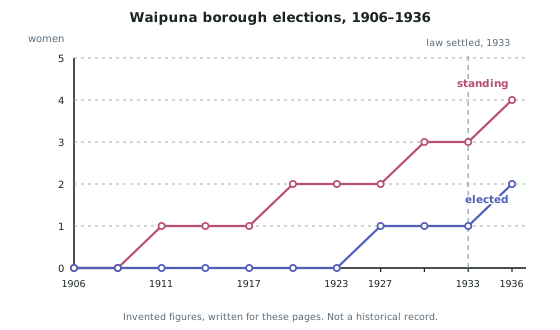
- Read the axes and the units first. A count of candidates and a percentage of candidates are different variables that can move in opposite directions.
- Find the turning points, not the trend. The line for women elected is flat at zero for twenty-one years and then is not. The year it changes is the question, and the year is the evidence.
- Compare the two lines against each other. Women stood from 1911 but none was elected until 1927. A gap between standing and winning is a different historical fact from either line alone, and noticing it is a conclusion beyond the obvious.
- Ask what the table cannot show. It counts candidates. It cannot show how many women considered standing and did not, why the successful candidate succeeded, or how many votes anyone received. Naming that limit is exactly the "relevant question a historian would ask" the paper asks for.
Worked Example
Worked example
Source E, the 1911 election handbill for Miss Alice Renwick (invented, written for this page), includes the lines: "Miss Renwick has served nine years on the Hospital Ladies' Committee" and "A woman's care of the household is the borough's care in little."
Read this source at all three layers.
Answer:
Layer 1 — what it says. The handbill states a fact about Renwick's experience — nine years on a hospital committee — and makes an argument that domestic management is comparable to borough management.
Layer 2 — what it shows. Two things must have been true for the committee to write this.
First, her supporters expected the objection to be experience, not principle, or they would not have led with a nine-year record. Second, they chose to argue from domesticity rather than from equal rights. That is a strategic choice, and it tells us what they believed would persuade Waipuna voters in 1911 — an equality argument was available and they did not use it.
Layer 3 — what it does not say, and why. A handbill exists to win votes, so it prints the strongest case and omits everything else. It does not mention what Renwick thought about any borough issue — drainage, rates, the gasworks — which suggests her committee judged that her suitability as a woman was the contest, and policy was not.
The question a historian would ask next: did other 1911 candidates' handbills discuss policy? If they did, the omission is deliberate and revealing. The booklet cannot answer that, and saying so is worth marks.