Homeostasis and negative feedback
What homeostasis is, and why it matters
-
Homeostasis is the maintenance of a stable internal environment within narrow limits, despite changes in the external environment or in the animal's own activity.
-
"Stable" does not mean constant. Conditions fluctuate within a narrow range around a set point, and the system continually corrects them.
-
The purpose is that cell processes only work within narrow physical and chemical limits. This is the reason the whole system exists, and stating it is required:
- Enzymes have an optimum temperature and pH. Outside a narrow range, reaction rates fall, and beyond it the enzyme's tertiary structure is disrupted and it is denatured.
- Cells require a particular water potential in the surrounding fluid. Too high, and water enters by osmosis and the cell swells or bursts; too low, and water leaves and the cell shrinks, so its contents become too concentrated for reactions to proceed normally.
- Respiring tissue requires a continuous oxygen supply and carbon dioxide removal, because accumulating CO2 lowers pH.
- Cells need glucose as a respiratory substrate at a reliable concentration — the brain in particular cannot store it and depends on a continuous supply.
-
The overall advantage: an animal maintaining a stable internal environment can remain active across a wide range of external conditions, rather than being restricted to conditions that happen to suit its cells.
The components of a control system
-
Every homeostatic system has the same four components. Identifying them is the fastest route into any answer.
-
The set point — the value the system maintains, such as approximately 37 °C in humans.
-
Receptors (sensors) — detect the current value and any deviation from the set point.
-
The control centre — compares the detected value with the set point and determines the response. For most systems this is in the hypothalamus or the medulla oblongata.
-
Effectors — the muscles or glands that carry out the response, restoring the value toward the set point.
-
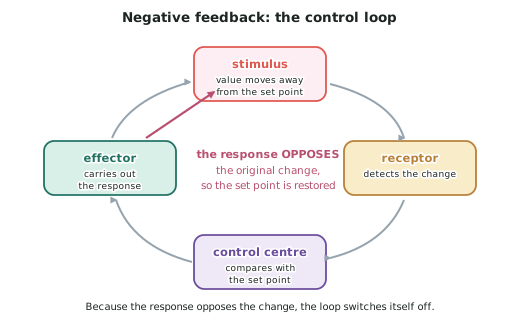
The pathway is always:
-
The loop is what makes it self-correcting. Because the response feeds back to oppose the original stimulus, the correction shuts itself off as the value returns to the set point — no separate "stop" signal is needed.
-
The signal from control centre to effector is carried by the nervous system (fast, short-lived) or by hormones in the blood (slower, longer-lasting), and many systems use both.
Negative feedback
-
Negative feedback is the mechanism of all five systems. The response opposes the original change, returning the value toward the set point.
-
The word negative refers to the direction of the response, not to anything harmful.
-
The cycle:
- A factor deviates from the set point.
- Receptors detect the deviation.
- The control centre triggers a response.
- Effectors produce a change in the opposite direction to the deviation.
- The value returns toward the set point.
- As it does, the stimulus weakens, so the response is reduced — this is what stops the system overcorrecting.
-
Two consequences worth understanding:
- The value oscillates slightly around the set point rather than sitting exactly on it, because correction can only begin after a deviation has been detected.
- The system is self-limiting: the response switches itself off as the value is restored, because the stimulus driving it disappears.
-
Most systems have opposing effectors — one set that raises the value and another that lowers it. This gives much finer control than a single mechanism, because the system can correct in either direction and can oppose an overshoot.
Positive feedback — and why it is not homeostatic
- In positive feedback, the response amplifies the original change rather than opposing it, driving the value further from its starting value.
- It is not homeostatic, because it does not restore stability. It is useful where a process needs to be driven rapidly to completion:
- Blood clotting, where activated platelets attract more platelets, so a clot forms quickly.
- Childbirth, where oxytocin increases contractions, which stimulates more oxytocin release.
- Positive feedback must terminate through some external event — the clot forming, or the birth occurring — because unlike negative feedback it contains no self-limiting mechanism.
Selective advantage
- The adaptive advantage of homeostasis is one of the three routes to Excellence, so it is worth being able to argue properly.
- It widens the range of conditions in which an animal can function. An animal maintaining a stable internal environment can stay active in conditions that would otherwise slow or stop its cell processes — so it can forage, escape predators and reproduce across a wider range of temperatures, water availability and activity levels.
- It allows a higher and more constant metabolic rate, because enzymes operate near their optimum continuously rather than only when external conditions happen to suit.
- It permits activity at times competitors cannot manage — at night, in cold conditions, or during sustained exertion.
- The cost is energy. Maintaining a set point requires continuous expenditure — heat production, ion pumping, hormone synthesis. Homeostasis is therefore favoured where the benefit of remaining active exceeds that cost, which is why endotherms require far more food than ectotherms of similar size.
Worked Example
Worked Example
An animal's body temperature is recorded over 24 hours in a fluctuating environment.
- Air temperature ranges from 4 °C to 26 °C.
- The animal's core temperature stays between 36.8 °C and 37.4 °C throughout.
- Recordings show core temperature rising slightly above 37.0 °C, then falling back, then dipping slightly below and rising again — a repeating small oscillation.
Explain what these data show about the control system, and explain why the temperature oscillates rather than remaining constant.
Answer:
What the data show.
Core temperature is held within a range of only 0.6 °C while the external environment varies by 22 °C. The internal value is therefore not tracking the external one, so it must be actively regulated rather than simply following the surroundings.
This is homeostasis: maintenance of a stable internal environment within narrow limits despite external change. The set point is approximately 37.0 °C.
The components responsible.
- Receptors — thermoreceptors in the skin detect external temperature, and thermoreceptors in the hypothalamus detect the temperature of the blood, which reflects core temperature.
- Control centre — the hypothalamus, which compares the detected temperature with the set point.
- Effectors — skin arterioles, sweat glands, and skeletal muscle.
- Responses — vasodilation and sweating when too warm; vasoconstriction and shivering when too cool.
Why the value oscillates rather than staying constant.
This is the key part of the question, and it follows directly from how negative feedback works.
- Correction can only begin after a deviation has been detected. The system cannot respond to a change that has not yet occurred, so temperature must move away from the set point before any response is triggered. Some oscillation is therefore unavoidable.
- The response then opposes the change. If temperature rises above the set point, vasodilation and sweating increase heat loss, so temperature falls.
- As the value returns toward the set point, the stimulus weakens, so the response is progressively reduced. This is what makes the system self-limiting and prevents indefinite overcorrection.
- However, there is a time lag between the response starting and the temperature actually changing — blood must be redistributed, sweat must evaporate. So the correction continues briefly after the set point is reached, carrying the value slightly past it in the other direction.
- That overshoot is then detected as a deviation in the opposite direction, and the opposing effectors respond — producing the repeating small oscillation seen in the data.
Why the oscillation is small. The animal has two opposing sets of effectors — mechanisms that increase heat loss and mechanisms that increase heat production. Because the system can correct in either direction, an overshoot is corrected almost immediately rather than being allowed to develop. A system with only one mechanism could correct only one way and would show much larger swings.
Why this matters. Holding temperature within 0.6 °C keeps enzymes operating close to their optimum continuously, so metabolic reactions proceed at a high and reliable rate whatever the external temperature. This allows the animal to remain active across the full 22 °C range rather than only when conditions happen to suit its cells — the adaptive advantage of the system.